The Complete Library
Arts integration or every classroom. Filter and sort resources based on your classroom.
Polygon Beats
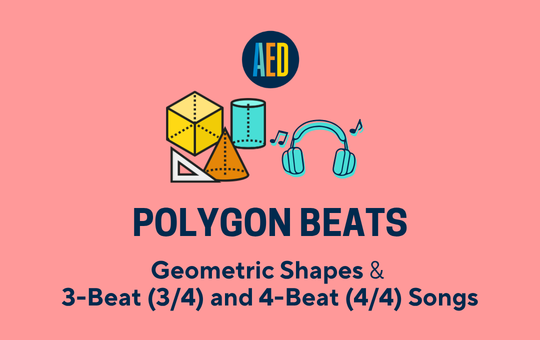
Students will learn about the two most basic time signatures in music, 3/4 (“three four”), also known as “3 beat,” and 4/4 (“four four”), also referred to as “4 beat.” Students will then apply their knowledge of 3-sided and 4-sided polygons, including triangles and squares, by drawing the shapes that match the time signatures they hear in a provided playlist of song snippets.
Rhythm Equivalence Game
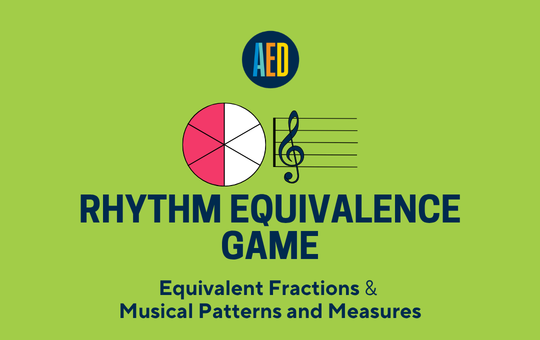
Students will use whole, half, quarter, and eighth notes to represent fractional parts of a measure. Students will play/clap these rhythms in pairs/groups to create equivalent measures.
Geographical Instruments
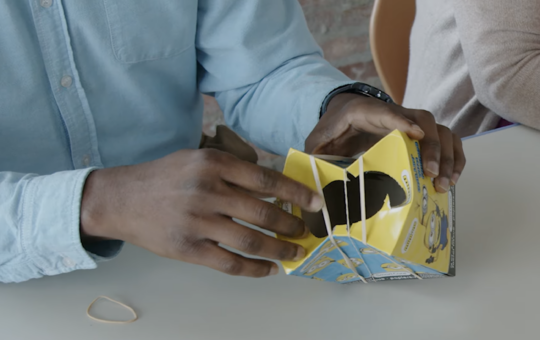
Students build on their knowledge of the physical geography of the New World and Old World, creating simplified versions of a string instrument and a shaker. They will then analyze how the availability of natural resources in each region influenced the development of these musical instruments.
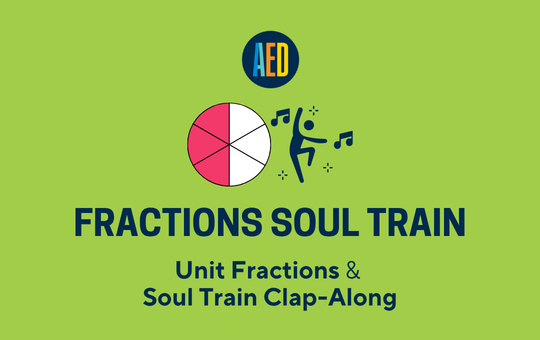
Fractions Soul Train
Students use whole, half, quarter, and eighth notes to identify and represent fractions. Students play/clap these rhythms and discuss how many claps/parts there are per measure, while making connections to fraction vocabulary (numerator, denominator, unit fraction). Students then work in groups to show measures as fraction strips and participate in a Soul Train clap-along.
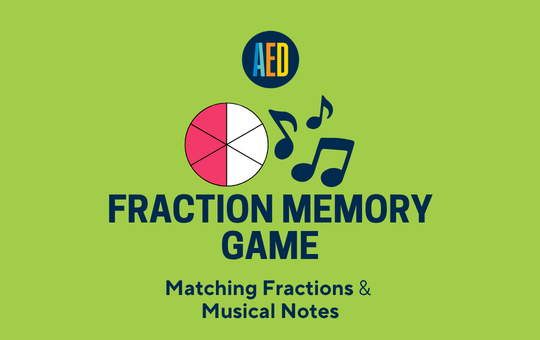
Fraction Memory Game
Students deepen their understanding of fractions by matching musical note values with their corresponding fractions. For example, a student who picks up a card with 3 quarter notes will be tasked with finding the matching card representing ¾.
10-15 MinsDifferentiateGrade 1KinderMathMovement & DanceMusicSmall GroupSubtractionSubtraction Within 10
Clap. Snap. Stomp. Subtract!
Students create and perform body percussion patterns using clapping, stomping, and snapping to represent and solve subtraction equations within 10.
Head Shoulders Knees Toes Place Value
Students use the familiar tune and movements of “Head, Shoulders, Knees, and Toes” to identify the place value of each digit in a multi-digit number.
Circle of Skip Counting!
Students practice skip counting while passing a clap around a circle to a steady beat. The group skip-counts by 2s, 5s, or 10s, saying one number with each clap. As students become more comfortable, increase the tempo to build fluency, listening, and automaticity.
Multiplication DJ: Representing Factors with Rhythm
Students become “DJs” and use rhythm and movement to represent a given multiplication equation. Each student creates a short body percussion beat sequence based on the first factor, then loops that sequence according to the second factor.

