
Home ➞ Digital Resource Library ➞ Math ➞
Clap. Snap. Stomp. Subtract!
Arts Integrated Small Group for Kinder Subtraction within 10 with Extension Options for Grade 1
Clap. Snap. Stomp. Subtract!
Pairs with Reveal Math Lessons Kinder: 7-4
In this teacher-led small group activity, students create and perform body percussion patterns using clapping, stomping, and snapping to represent and solve subtraction equations within 10.
Standards
Getting Ready
Downloads
TEACH!
Brain Connections
Creators
MARYLAND STATE STANDARDS
MD Math Standards:
- K.AT.A.1 – Represent addition and subtraction situations (presented with numerals or mathematical symbols) within 10 with objects, fingers, drawings, sounds (e.g., claps), acting out situations, using verbal explanations, and/or writing expressions and equations
- K.AT.A.2 – Solve addition and subtraction problems in context (add to, take from, put together/take apart) within 10 and represent by using objects, drawings, and/or equations
This activity supports enduring understanding of the given standards by providing students with a meaningful, multisensory way to represent and solve subtraction situations within 10. Rather than relying only on pictures or manipulatives, students use music and movement to model subtraction by creating rhythmic patterns (clap, stomp, snap) and then removing beats to represent taking away.
MD Arts Standards:
- MU.AS1.1:P-2:1 – Generate musical ideas for an artistic purpose, using appropriate technology as available.
- DA.AS3.E:P-2:2 – Use information from created work to vary it using the BEST principles. Clearly communicate choices.
Studentes use rhythmic patterns as a creative form of representation. Rather than simply counting objects, they transform mathematical ideas into musical patterns through body percussion. As students create, perform, and modify rhythms to represent “taking away,” they make meaningful connections between music and mathematics. The rhythm becomes a concrete model that helps students internalize the concept of subtraction while engaging multiple senses through movement, sound, and pattern.
Through this integration, students deepen both their mathematical understanding and their ability to communicate ideas creatively, demonstrating that artistic expression can be a powerful tool for making sense of mathematical concepts.
OUTSIDE OF MD?
Common Core State Standards:
- K.OA.A.1 – Represent addition and subtraction with objects, fingers, mental images, drawings, sounds (e.g., claps), acting out situations, verbal explanations, expressions, or equations.
- K.OA.A.2 – Solve addition and subtraction word problems, and add and subtract within 10, e.g., by using objects or drawings to represent the problem.
National Arts Standards:
- Anchor Standard 1
- MU:Cr1.1.K – a) With guidance, explore and experience music concepts (such as beat and melodic contour.) b) With limited guidance, generate musical ideas in multiple tonalities (such as major and minor) and meters (such as duple and triple).
ARTS INTERATED LEARNING OBJECTIVE
I can use body percussion patterns (with clapping, stomping, and snapping) to show subtraction as taking away within 10.
MATH DOMAIN
- Operations and Algebraic Thinking → Understand addition as putting together and adding to, and understand subtraction as taking apart and taking from → Represent and Solve Subtraction problems
COHERENCE
- Before: Solve subtraction problems within 10.
- After: Solve subtraction problems when the total, both parts, and one part is unknown (Grade 1)
MATH & ART SKILLS
- Math: Represent and solve subtraction situations within 10.
- Art: Creating rhythmic patterns using body percussion.
MATERIALS
- Dry erase surface & marker
- Visual Percussive Cards
- Pencil
- Attached worksheet for student recording
- Student Self Assessment of Skill



GETTING READY
This activity should be completed in a teacher-led small group.
Facilitation time: 15-20 minutes
Before the Lesson
- Prepare Visual Percussive Cards before the lesson
- Prepare/ copy student recording sheets
- Seat students where they have enough space to safely perform body percussion while remaining in their seats or standing beside them. This can be done at a small group table.
- Begin with numbers within 5. Only move to within 10 when students begin to demonstrate understanding
Introduce the skill and state the “why”
“Today we are going to use our bodies to help us solve subtraction problems! We know subtraction means taking away. We will use claps, stomps, and snaps (body percussion movements) to show a subtraction story. Every one sound/movement = one beat.”
Review the visual cue cards
Ask: “What does subtraction mean?”
Possible Student Response:
- “It means take away.”
- “It means some are gone.”
- “It means less.”
- “You start with some and then take some away.”
- “The number gets smaller.”
- “You lose some.”
Ask: “What happens when we take something away?”
Possible Student Response:
- “There are fewer left.”
- “The number gets smaller.”
- “Some are gone.”
- “We have less.”
- “The total changes.”
- “We count what’s left.”
MODEL THE ACTIVITY
“Watch how my sounds can tell a subtraction story.”
Place the 5 clap visual percussion cards on the table.
Example 1 (Within 5)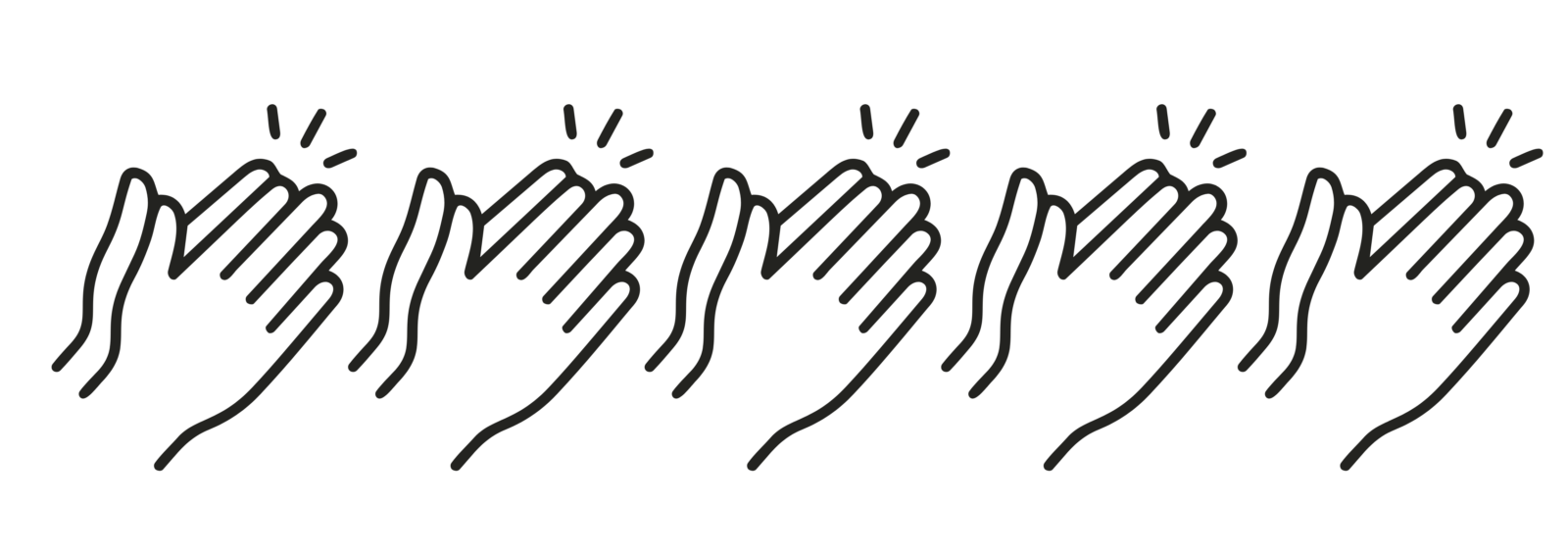
“I start with 5 claps.” Perform all five claps together.
Remove one clap card. Perform the action of “taking it away.”
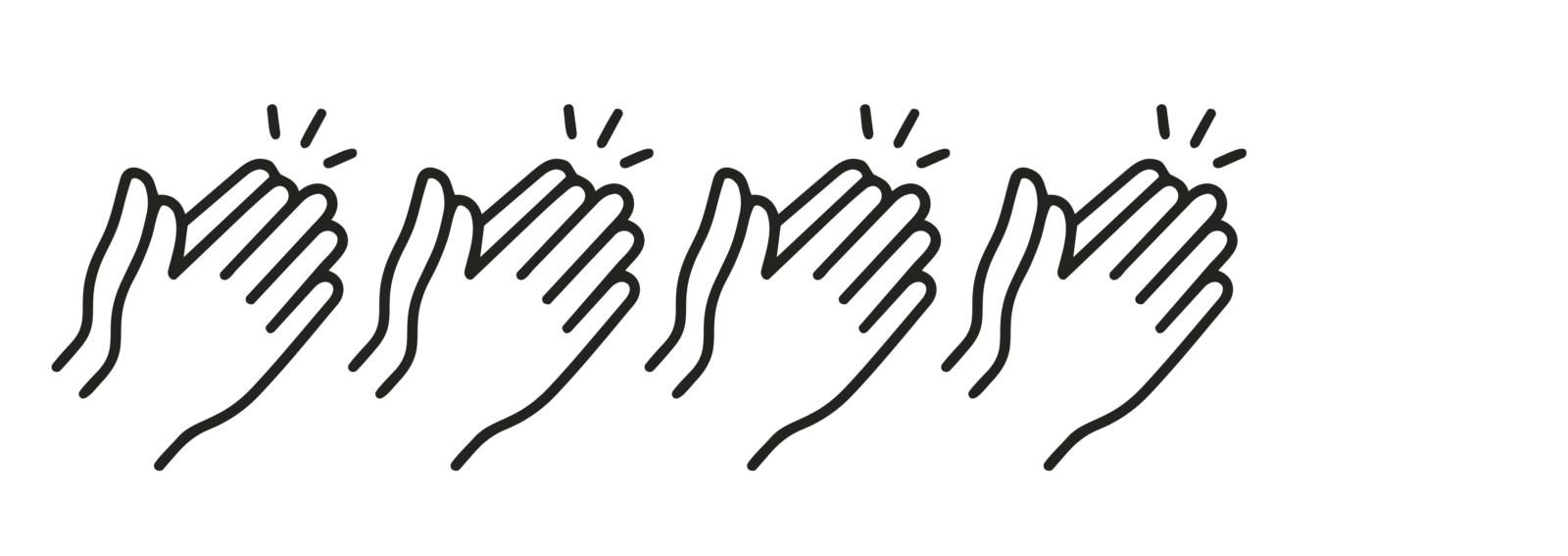
“I took away 1 clap.” Perform the remaining 4 claps.
Ask:
“How many claps are left?”
“What subtraction equation matches?”
Student response: 5 − 1 = 4
“How do we know what numbers to put in the equation?”
“Let’s try another one together”

Perform the pattern. Remove the last clap card.
Perform the remaining pattern.
Ask:
“How many beats are left?”
“What changed?”
Student response: 4 − 1 = 3
Emphasize:
“When we remove a beat, it shows we are taking something away, just like subtraction.”
GUIDED PRACTICE
*If students demonstrate understanding, challenge to represent problems within 10. If not, stay within 5.*
- Give each student a set of visual cue cards.
- Present a subtraction problem within 5 (or 10 based on student understanding)
- Build a five-beat or ten-beat pattern using any combination of clap, stomp, and snap cards.
- Perform the complete pattern together. (Make sure to guide students through this process. Everyone should have the same beat for this practice)
- Repeat with several examples:
Examples of problems to complete within 5:
- 2 − 1 = 1
- 3 − 1 = 2
- 3 − 2 = 1
- 4 − 1 = 3
- 4 − 2 = 2
- 4 − 3 = 1
- 5 − 1 = 4
- 5 − 2 = 3
- 5 − 3 = 2
- 5 – 4 = 1
Examples of problems to continue to complete within 10:
- 6 − 1 = 5
- 6 − 2 = 4
- 6 − 3 = 3
- 7 − 1 = 6
- 7 − 2 = 5
- 7 − 3 = 4
- 7 − 4 = 3
- 8 − 1 = 7
- 8 − 2 = 6
- 8 − 3 = 5
- 8 − 4 = 4
- 9 − 1 = 8
- 9 − 2 = 7
- 9 − 3 = 6
- 9 − 4 = 5
- 9 − 5 = 4
- 10 − 1 = 9
- 10 − 2 = 8
- 10 − 3 = 7
- 10 − 4 = 6
- 10 − 5 = 5
INDEPENDENT PRACTICE
Students create their own rhythmic pattern. Share with the group and record thinking on the subtraction worksheet.
Encourage students to solve each other’s subtraction problems.
CLOSING
Bring students back together.
Ask: “How did removing a beat help us show subtraction?”
Possible Student response:
- “It showed taking away.”
- “It made the pattern smaller.”
- “We had fewer beats.”
- “It helped us see what was left.”
- “It showed subtraction.”
“How did the sounds help you solve the problem?”
Possible Student response:
- “I could count the beats.”
- “The sounds helped me keep track.”
- “I knew how many were left.”
- “It was easier to see the answer.”
- “I could hear the subtraction.”
“What did you notice when the pattern got shorter?”
Possible Student response:
- “There were fewer beats.”
- “The number got smaller.”
- “Some beats were gone.”
- “There was less to count.”
- “It matched the subtraction story.”
End by reinforcing:
“Today we used sounds, movement, and equations to show subtraction. We used our bodies to help us understand what it means to take away.”
Provide students with self-assessment to reflect on understanding of the given skill.
ASSESSMENT & REFLECTION
Teacher will informally observe students as they complete the given activity. Teacher can formally check for understanding through completion of the subtraction worksheet.
DIFFERENTIATION
Differentiation for this activity should focus on providing supports and extensions within the intervention rather than creating a separate intervention.
Accommodations and Adaptations
- Reduce the total number of beats to 5 for students who need additional support before progressing to 10. This can also be done without requiring a given equation.
- Model each body percussion pattern first using a gradual release approach (“I do, We do, You do”).
- Provide visual cue cards (clap, stomp, snap) to support memory and sequencing.
- Allow students to use fingers or manipulatives alongside the rhythmic patterns to reinforce the connection between movement and subtraction.
- Encourage students to verbalize the subtraction action using sentence stems such as, “I started with ___. I took away ___. I have ___ left.”
Extension
- Increase complexity by representing and solving subtraction situations within 20 using body percussion and writing corresponding equations. Students can compare multiple subtraction strategies and explain how the rhythmic pattern matches the equation. (1.OA.A.1)
- Challenge students to create their own rhythmic subtraction story for a partner to solve.
BRAIN TARGETED TEACHING IN THE CLASSROOM
Students create and perform body percussion patterns to physically model subtraction. By experiencing the action of taking away through movement, students build a deeper conceptual understanding of subtraction within 10 before recording their thinking with mathematical models and equations.
Using Movement to Strengthen Understanding – Embodied Cognition
The Emotional Climate:
The Physical Space:

Learn More:
Learn more about Brain Targeted Teaching via Dr. Mariale Hardiman’s site.
ROOT BRANCH MEDIA GROUP – BRING ROOT BRANCH TO YOUR SCHOOL!
All video content made in partnership with Baltimore’s Root Branch Media Group.
JAZSMINE MCDONALD
A certified K–12 dance educator and advanced professional, Jazsmine is passionate about the power of visual and performing arts. She launched her teaching career in New York City, earning her Bachelor’s degree in performing arts from Long Island University and her Master’s in education from CUNY Hunter College. Now in her seventh year of teaching, Jazsmine has centered her career on arts integration, backed by an Administration I certification and impactful collaboration with Arts Every Day. Her expertise combines technical dance training with culturally responsive teaching, resulting in a pedagogy grounded in the Danielson Framework and Universal Design for Learning. Through arts enrichment, she reshapes how young minds approach expression, translating dance into vital life skills and character development.
ALEXANDRIA FORGIONE
Alexandria Forgione is an Instructional Math Coach at Moravia Park Elementary School in Baltimore City Public Schools. With over 11 years of experience in education, she has served as both a classroom teacher for grades K-4 and instructional leader, supporting teachers and students in strengthening mathematics instruction and achievement. Alexandria is passionate about building teacher capacity through coaching, collaborative planning, and meaningful classroom support. She is currently pursuing a degree in Educational Leadership at Towson University, where she focuses on equity-centered leadership and school improvement. Her work is grounded in the belief that all students can be successful mathematicians when provided with meaningful learning experiences and strong support systems. Outside of education, Alexandria enjoys spending time with her family and friends, supporting her 6 year old in her soccer journey, and seeking out new adventures near and far.
