The Complete Library
Arts integration or every classroom. Filter and sort resources based on your classroom.
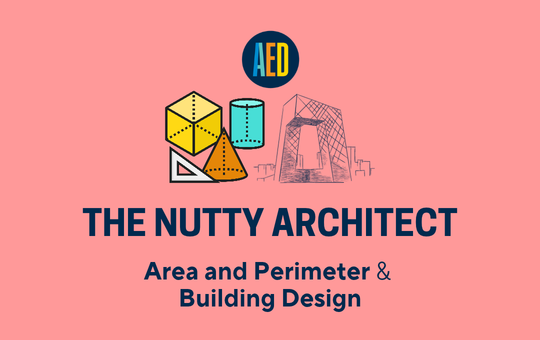
The Nutty Architect: A Geometry Design Challenge
Students explore photographs of unusual architecture for inspiration before creating their own abstract, playful building designs. Using grid paper, they arrange four specified quadrilaterals and a composite shape to form the foundation of their building. Students then draw and calculate the area and perimeter of each shape.
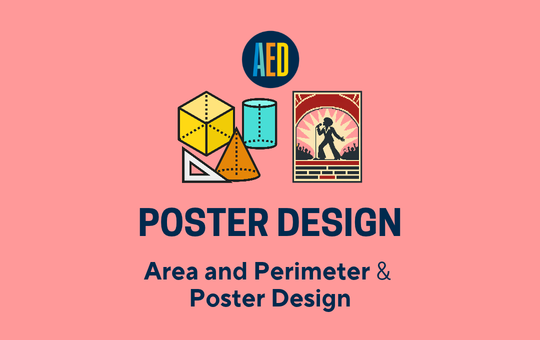
Poster Design with Area & Perimeter
Students begin by studying classic posters, examining how geometric shapes, layout, and color contribute to a design's overall mood and effectiveness. They then apply these ideas to create compelling flyers that incorporate text, shapes, and images while demonstrating their understanding of area and perimeter.
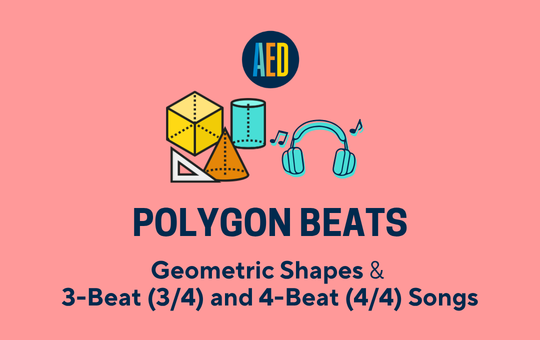
Polygon Beats
Students will learn about the two most basic time signatures in music, 3/4 (“three four”), also known as “3 beat,” and 4/4 (“four four”), also referred to as “4 beat.” Students will then apply their knowledge of 3-sided and 4-sided polygons, including triangles and squares, by drawing the shapes that match the time signatures they hear in a provided playlist of song snippets.
Rhythm Equivalence Game
Students will use whole, half, quarter, and eighth notes to represent fractional parts of a measure. Students will play/clap these rhythms in pairs/groups to create equivalent measures.
Fractions Soul Train
Students use whole, half, quarter, and eighth notes to identify and represent fractions. Students play/clap these rhythms and discuss how many claps/parts there are per measure, while making connections to fraction vocabulary (numerator, denominator, unit fraction). Students then work in groups to show measures as fraction strips and participate in a Soul Train clap-along.
Puzzle Murals
Students will examine two copies of the same mural that have been partitioned into equal parts. (For example, one copy will be partitioned into fourths, and one will be partitioned into eighths.) Students will be tasked with putting the puzzle pieces back together to show their original images. The intent is for each student to recognize that some of the partitioned parts are equivalent (1/4=2/8).
Fraction Memory Game
Students deepen their understanding of fractions by matching musical note values with their corresponding fractions. For example, a student who picks up a card with 3 quarter notes will be tasked with finding the matching card representing ¾.
Partitioning Baltimore Murals
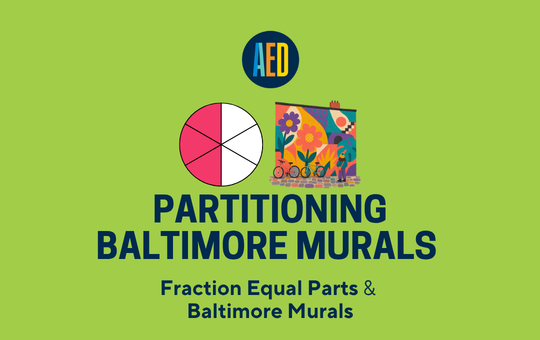
Students view murals from various locations throughout Baltimore City and discuss how partitioning was used to divide them into equal parts (halves, thirds, fourths, sixths, etc.). Teachers will also discuss the background, location, and motivation for creating the murals.
Equation Scenes
Students use a word problem and a guided flow chart to identify key information, select the appropriate operation, and solve the problem. They then write and perform a short scene that brings the word problem to life, using movement and dialogue to demonstrate their mathematical understanding.

