Arts Integrated Math Resources
Search by key word or filter by grade level, curriculum, art form, standard, topic, and/or author to find the arts integrated experience that best fits your classroom.
Polygon Beats
Students will learn about the two most basic time signatures in music, 3/4 (“three four”), also known as “3 beat,” and 4/4 (“four four”), also referred to as “4 beat.” Students will then apply their knowledge of 3-sided and 4-sided polygons, including triangles and squares, by drawing the shapes that match the time signatures they hear in a provided playlist of song snippets.
Rhythm Equivalence Game
Students will use whole, half, quarter, and eighth notes to represent fractional parts of a measure. Students will play/clap these rhythms in pairs/groups to create equivalent measures.
Geometry in Photography
Students will examine three photographs and identify as many geometric shapes, elements, and concepts as possible through a guided discussion. While students evaluate the photographs for their geometric connections, the provided questions will encourage them to evaluate core photographic principles, such as light, composition, and emotion.
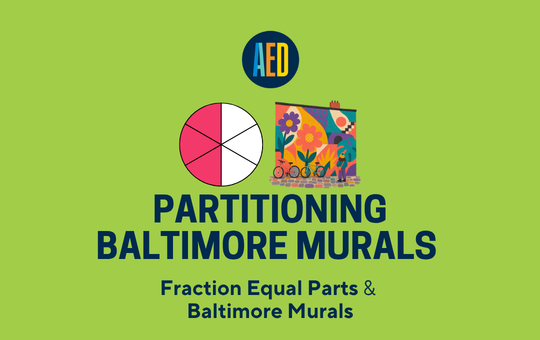
Partitioning Baltimore Murals
Students view murals from various locations throughout Baltimore City and discuss how partitioning was used to divide them into equal parts (halves, thirds, fourths, sixths, etc.). Teachers will also discuss the background, location, and motivation for creating the murals.
Visual Art Addition Within 100
Students analyze a piece of jewelry by Douriean Fletcher to practice looking for groups, patterns, and quantities. Through Notice & Wonder and partner discussion, students connect what they see to strategies for adding two-digit numbers within 100.
Circle of Skip Counting!
Students practice skip counting while passing a clap around a circle to a steady beat. The group skip-counts by 2s, 5s, or 10s, saying one number with each clap. As students become more comfortable, increase the tempo to build fluency, listening, and automaticity.
Multiplication DJ: Representing Factors with Rhythm
Students become “DJs” and use rhythm and movement to represent a given multiplication equation. Each student creates a short body percussion beat sequence based on the first factor, then loops that sequence according to the second factor.
Multiplication Secret Handshake
Students create a “secret handshake” that represents a multiplication equation, choreographing a sequence of unique movements based on the first factor, then repeats the sequence according to the second factor.
