By Gabrielle Whitehurst, Youth Initiatives Manager

Arts every day has had a busy year with both new programs and exciting updates to existing ones. This summer, we piloted a curatorial practicum summer program for students titled Curate Now: Youth Voice in Art + Archives. Students curated their own exhibition, Webs of Oppression: Youth threading New Futures, centered around Baltimore archives, while building the skills to continue their work in GLAM (galleries, libraries, archives, and museums). Through focused writing workshops, site visits with local museums and archives, and thoughtful collaboration with their peers, students left with a toolkit that prepared them in both pursuing and transforming higher education pathways and GLAM careers. This experience also introduced me to a lot of lessons that I am bringing with me in my own work with my colleague Weiwen Balter, Baltimore Arts Education Initiatives Manager, on the Baltimore Youth Arts Advocacy Council (BYAAC) and working on our 11th annual 10×10 Exhibit with high school curators.
Curricular collaboration with CHARM: Voices of Baltimore Youth, has been a throughline between both Curate Now and BYAAC this year. Through our work with Curate Now interns, we realized the urgency of targeted and intentional foci in both explanatory and narrative writing. In curation, we communicate with vast audiences, having to be succinct and clear in our language. This formalized and claim-based style of writing proves central in advocacy as well. Through BYAAC, students write their own testimonials to advocate for arts education access and present them to local and state political leaders. Narrative writing and reading helps students jump into new perspectives, consider experiences outside of themselves, and offers numerous ways to see themselves in new lights.

Since both programs are also receiving funding this year from Maryland State Department of Education grants, the importance of career-readiness and subsequent evaluative transparency is emphasized in both of our youth initiatives. Coming from an artistic background, quantitative data analysis intimidated me during the planning period of Curate Now. How can we create a check-in that is accessible for students, doesn’t impose unrealistic expectations, but provides accountability for our program and the feelings of students? Over time, we began to tailor our evaluative methods to different audiences, and consider how they could be streamlined. With BYAAC this school year, we’ve been doing monthly social, emotional, and college and career readiness check-ins with students to get a more regular sense of how the program can be shifted in small and actionable ways. This has proved invaluable for the efficacy of both youth programs.
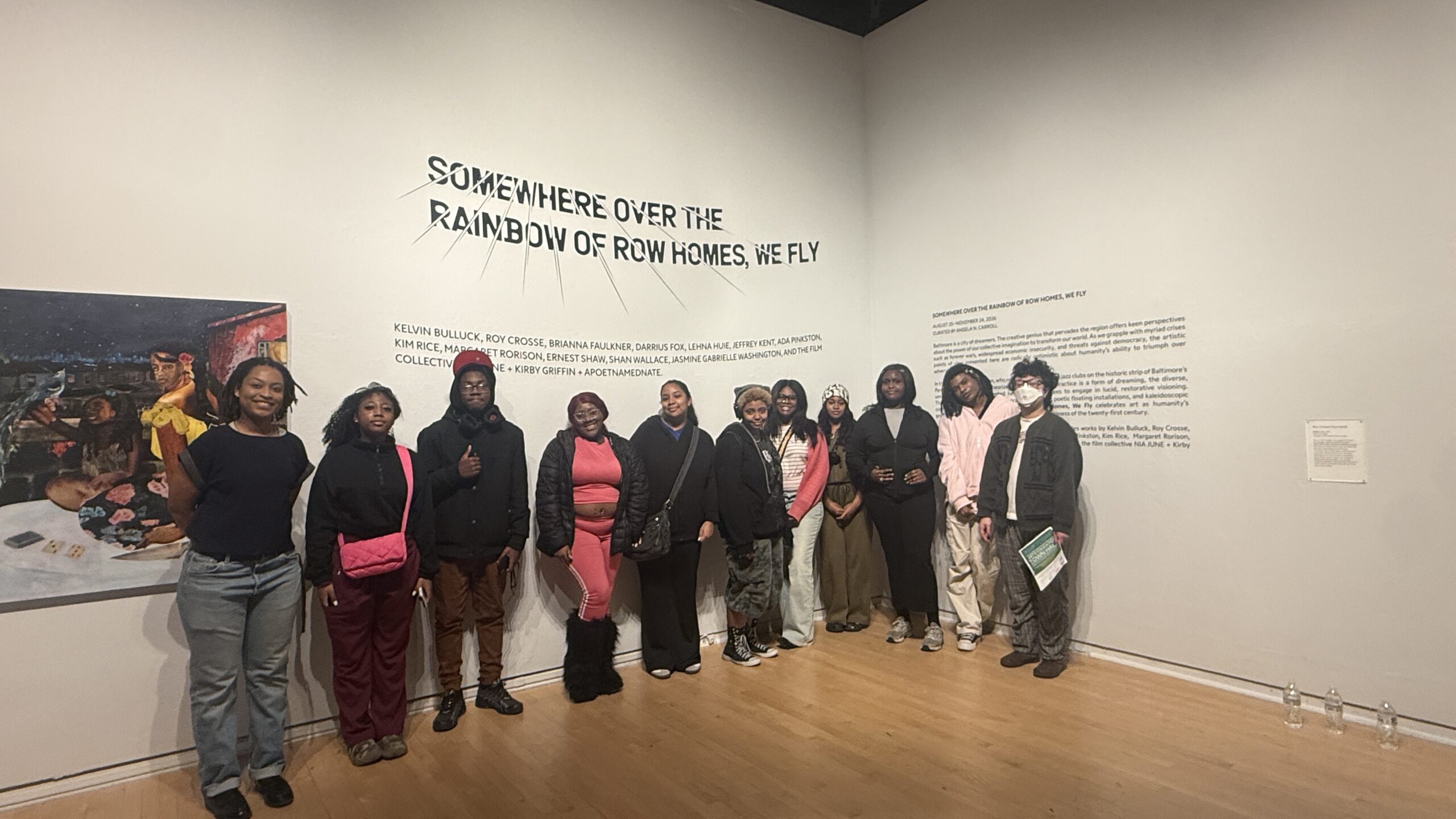
BYAAC embodies many elements of curation, from engaging diverse audiences, to speaking about one’s relationship with the arts. Last week, on November 19th, our BYAAC students went on a field trip sponsored by UMBC’s Center for Art, Design, and Visual Culture to see Somewhere Over the Rainbow of Row Homes, We Fly, an intergenerational group exhibition organized by curator Angela N. Carroll. There, students were able to hear from Baltimore-raised artists Ernest Shaw, Jasmine Gabrielle Washington, and Darrius Fox and Baltimore-based artist Kelvin Bullock during a panel on memory, communal and familial photographic archives, and land sovereignty.
My biggest take away is that the main goal of their art and this exhibition is to bring people together,

In a beautiful tie-in with both programs, artists spoke to the importance of collaboration and relationships as a creative. Ernest Shaw proclaimed that you do not define yourself as an artist, that art, being inherently relational means that the audience makes the art. We consider art as a way of steering our own narratives. Within the council, we explain how the arts and arts education contribute to our lives and stories; We analyze the criticality of arts and effectively convey that information to local leaders. Right now, the students are promoting their annual Arts Education Town Hall event to audiences of artists, educators, and students. In Curate Now, we enact this narrative through creation of an exhibition. Students are able to uplift their everyday experiences, and the experiences of people and places that have been rendered invisible. All of this is made possible through our numerous partnerships and collaborations with local institutions such as UMBC, CHARM: Voices of Baltimore Youth, Glenstone Museum, The Walters Art Museum, Billie Holliday Center for Liberation Arts, Goucher College, and MICA.
One of the biggest takeaways was the bond that all of the artists and the way they supported each other.
