Home ➞ Digital Resource Library ➞ ELA ➞
Playing with Words & Songs
Arts Integrated Lesson Plans and Materials for Teaching Literary and Musical Language & Wit & Wisom Grade 5 “Word Play”
Who’s on First

Pairs with Wit & Wisdom Lesson 2
This activity uses the collective Call and Response song form to engage students in the module text and comedy routine, “Who’s on First?,” quoting from the text while also building classroom rapport by fostering collaboration and self/social awareness.
Standards
Getting Ready
Downloads
TEACH!
Brain Connections
Creators
COMMON CORE STATE STANDARDS
- CCSS.ELA-Literacy.RL.5.1 – Quote accurately from a text when explaining what the text says explicitly and when drawing inferences from the text.
- CCSS.ELA-Literacy.RL.5.4 – Determine the meaning of words and phrases as they are used in a text, including figurative language such as metaphors and similes.
- CCSS.ELA-Literacy.W.5.5 – With guidance and support from peers and adults, develop and strengthen writing as needed by planning, revising, editing, rewriting, or trying a new approach. (Editing for conventions should demonstrate command of Language standards 1-3 up to and including grade 5 here.)
NATIONAL ARTS STANDARDS
- MU:Cr1.1.5a – Improvise rhythmic, melodic, and harmonic ideas, and explain connection to specific purpose and context (such as social, cultural, and historical).
LEARNING OBJECTIVE
- This activity uses the collective Call and Response song form to engage students in the module text and comedy routine, “Who’s on First?” in alignment with the CCSS learning targets outlined in lesson 2 of the 5th Grade Wit & Wisdom Module, “Word Play.” In addition, this activity helps build classroom rapport by fostering collaboration and self/social awareness (CASEL, 2022).
STRATEGY
- Call and Response is both an engagement tool and technique for deepening content memory. It’s also important to note that as one of the first song-making activities of the unit, the entry point for music-making is easy and fun in order to give everyone a little confidence and show how simple music-making can be for just about anyone.
WELCOME + OVERVIEW
- In this unit, students will learn how authors and songwriters use language and wordplay to convey meaning, develop themes, and engage with the world around them. Through a variety of basic song structures, students will apply acquired content knowledge and express understanding of grade-level reading, writing, and speaking skills.
CONCEPT MAP
TEACHER TOOLS FOR “NON-MUSICIANS”
FEEDBACK TOOLS
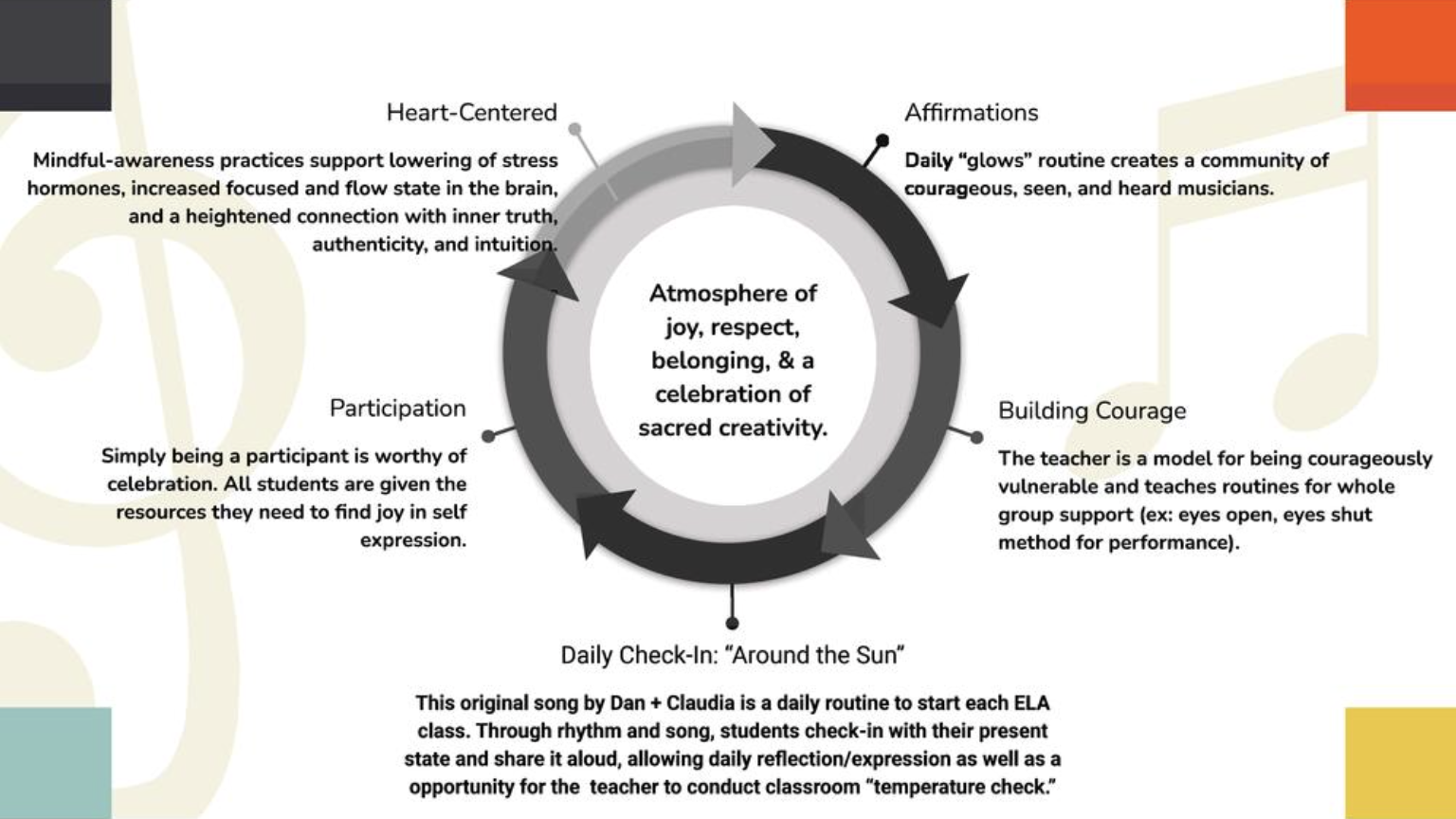
- Glows – Students reflect on their own learning and celebrate their peers by sharing affirmations (“glows”) aloud.
- Bells and Whistles – Cheers, chants, gestures, or sounds that spread encouragement throughout performing experiences
- Check-Ins – Teacher builds rapport with consistent one-on-one student check-ins (celebratory and constructive feedback)



DIRECTIONS
1. Students watch and listen to the module text “Who’s on First?” As they do, students are instructed to take Notice and Wonder notes in their journals.
2. After viewing the text and collecting their notes, the teacher leads a discussion of what the students observed and the questions they had. The teacher instructs each student to circle ONE of their Notices or Wonders.
3. The teacher explains that we will now create a song together about our observations and questions.
4. The teacher taps out a beat on their legs or on the top of the desk. After several measures, they invite the students to join in. The tempo (or speed) should be moderate like the ticking of a clock.
5. The teacher counts 1 – 2 – 3 – 4 several times to help students understand the bar (or measure) and establish a beat for the song.
6. The teacher sings (or speaks) the line “Who’s on First?” starting on the 1st tap of the measure. This is going to be the Response. The three words, Who’s on First, should fall on the first three beats. This will probably begin to happen naturally.
7. The teacher invites the class to join in, adding the lyrics to the beat, to get the feel of it.
8. Once everyone is comfortable with this, the teacher explains that the Call, or alternate lines, will be the Notice or Wonder the students circled from their notes. The teacher provides a model using an example from one of the students’ own notes.
9. Students practice reading their chosen note aloud, and the teacher assigns the order the Calls will move in (note: setting up the physical environment with a circular seating formation may be helpful). Students are reminded that after each individual Call line, all students sing the Response, “Who’s on First?”
10. Once the directions are clear and everyone understands the concept, begin the song with a Call from one of the students followed by the Response “Who’s on First?” by all
11. Go around until everyone has had a chance to participate.
EXTENSION
1. Rhyming lines: Students can write a rhyming couplet (two lines that end in a rhyme, also known as an A/A pattern) about the text. The student would Call their first line to the class, and the class would Respond with “Who’s on First?” Then, that same student would Call out their second (rhyming) line, and again the class would Respond with “Who’s on First?”
2. Word meaning: Bring students’ attention to the Deep Dive vocabulary terms present in the text, like the word “peculiar.” Have each student write a Call line using the word in their own sentence or stating a synonym for the word.
3. Homophones: With students, identify the words in the text that also exist as homophones. Students work in teams to create a Call line using one of the identified homophone pairs.
4. Chorus creation: To extend the song form, the class could create a Chorus to be sung after every 3 – 4 students share their Call.
Chorus example:
Tell me, can you tell me?
Who’s on First?
Tell me, can you tell me?
Who’s on first?
ADDITIONAL RESOURCES
Below are some examples of how Call and Response songs show up in many gospel, jazz, African children’s music, rock and roll, and work and protest songs. We highly encourage you to share these works with your students, and they can even be used to play in the background while students prepare their lines.
-
- Georgia Sea Island Singers – Pay Me My Money Down (singing starts at :30)
- Call and Response in Gospel Music
- Drum and Piano Call and Response
- School Children Kenya call and response
- African Origins / Little Richard
- Oh zim zim
- No justice no peace
BRAIN TARGETED TEACHING IN THE CLASSROOM
The Emotional Climate:
The Physical Environment:
Learn More:
Learn more about Brain Targeted Teaching via Dr. Mariale Hardiman’s site and explore the arts integrated overlay below:
ROOT BRANCH MEDIA GROUP – BRING ROOT BRANCH TO YOUR SCHOOL!
All video content made in partnership with Baltimore’s Root Branch Media Group.
DAN + CLAUDIA ZANES – BRING THE ZANES TO YOUR SCHOOL!
Haitian-American jazz vocalist and music therapist Claudia Zanes and Grammy Award winning all-ages entertainer Dan Zanes have been making music together since the day they met in 2016. During their time together the two have toured extensively; written and performed Night Train 57: A Sensory Friendly Comic Folk Opera for the Kennedy Center; created House Party: A Family Roots Music Treasury songbook for Quarto Publishing Group; and released their first record as a duo, Let Love Be Your Guide, for Smithsonian Folkways. Their follow-up Folkways album, Pieces of Home, was released in August, 2024. Vocals! Guitar! Flute! Percussion! Trombone! Harmonica! Jaw Harp! Dan and Claudia bring their social electric folk music with them wherever they go. People attend the highly interactive concerts knowing they’ll be singing along and dancing to a sound that lies at the center of Haitian folk, early rock and roll, sea shanties, Black gospel and blues. Learn more at https://danandclaudia.com/.
RACHAEL BARILLARI
Rachael Barillari is the manager of the Baltimore Arts Integration Project and the founder of Soul Stori LLC, which produces integrative curricula and resources that seamlessly incorporate SEL and the arts into educational settings. She has served as an Adjunct Professor at Johns Hopkins’ School of Education and has authored several publications, including “The Compassion Formula: Where Head Meets Heart For Greater Well-Being.” Her work emphasizes compassionate and holistic learning environments that nurture every child’s creative core. Rachael holds a Masters in Teaching from JHU and a Masters in Educational Psychology from Columbia University. She is a certified Integrative Wellness Coach and HeartMath Trainer, as well as a former Baltimore City Schools teacher.
I Spy Homophones
Pairs throughout Wit & Wisdom Module
This activity serves as thread throughout the module for students to collect homophone pairs in a variety of texts. I Spy Homophones can also be used as a learning game that is adapted all year long!
Standards
Getting Ready
Downloads
TEACH!
Brain Connections
Creators
COMMON CORE STATE STANDARDS
- CCSS.ELA-Literacy.RL.5.4 – Determine the meaning of words and phrases as they are used in a text, including figurative language such as metaphors and similes.
- CCSS.ELA-Literacy.L.5.4.a – Use context (e.g., cause/effect relationships and comparisons in text) as a clue to the meaning of a word or phrase.
- CCSS.ELA-Literacy.L.5.5.c – Use the relationship between particular words (e.g., synonyms, antonyms, homographs) to better understand each of the words.
- CCSS.ELA-Literacy.L.5.4.c – Consult reference materials (e.g., dictionaries, glossaries, thesauruses), both print and digital, to find the pronunciation and determine or clarify the precise meaning of key words and phrases.
NATIONAL ARTS STANDARDS
- MU:Cr1.1.5a – Improvise rhythmic, melodic, and harmonic ideas, and explain connection to specific purpose and context (such as social, cultural, and historical).
LEARNING OBJECTIVE
- Students will identify and analyze homophone pairs as they work through module texts.
WELCOME + OVERVIEW
- In this unit, students will learn how authors and songwriters use language and wordplay to convey meaning, develop themes, and engage with the world around them. Through a variety of basic song structures, students will apply acquired content knowledge and express understanding of grade-level reading, writing, and speaking skills.
CONCEPT MAP
TEACHER TOOLS FOR “NON-MUSICIANS”
FEEDBACK TOOLS
- Glows – Students reflect on their own learning and celebrate their peers by sharing affirmations (“glows”) aloud.
- Bells and Whistles – Cheers, chants, gestures, or sounds that spread encouragement throughout performing experiences
- Check-Ins – Teacher builds rapport with consistent one-on-one student check-ins (celebratory and constructive feedback)
HOW TO FACILITATE
Watch the video below to facilitate this activity:
BRAIN TARGETED TEACHING IN THE CLASSROOM
The Emotional Climate:
The Physical Environment:
Learn More:
Learn more about Brain Targeted Teaching via Dr. Mariale Hardiman’s site and explore the arts integrated overlay below:
ROOT BRANCH MEDIA GROUP – BRING ROOT BRANCH TO YOUR SCHOOL!
All video content made in partnership with Baltimore’s Root Branch Media Group.
DAN + CLAUDIA ZANES – BRING THE ZANES TO YOUR SCHOOL!
Haitian-American jazz vocalist and music therapist Claudia Zanes and Grammy Award winning all-ages entertainer Dan Zanes have been making music together since the day they met in 2016. During their time together the two have toured extensively; written and performed Night Train 57: A Sensory Friendly Comic Folk Opera for the Kennedy Center; created House Party: A Family Roots Music Treasury songbook for Quarto Publishing Group; and released their first record as a duo, Let Love Be Your Guide, for Smithsonian Folkways. Their follow-up Folkways album, Pieces of Home, was released in August, 2024. Vocals! Guitar! Flute! Percussion! Trombone! Harmonica! Jaw Harp! Dan and Claudia bring their social electric folk music with them wherever they go. People attend the highly interactive concerts knowing they’ll be singing along and dancing to a sound that lies at the center of Haitian folk, early rock and roll, sea shanties, Black gospel and blues. Learn more at https://danandclaudia.com/.
RACHAEL BARILLARI
Rachael Barillari is the manager of the Baltimore Arts Integration Project and the founder of Soul Stori LLC, which produces integrative curricula and resources that seamlessly incorporate SEL and the arts into educational settings. She has served as an Adjunct Professor at Johns Hopkins’ School of Education and has authored several publications, including “The Compassion Formula: Where Head Meets Heart For Greater Well-Being.” Her work emphasizes compassionate and holistic learning environments that nurture every child’s creative core. Rachael holds a Masters in Teaching from JHU and a Masters in Educational Psychology from Columbia University. She is a certified Integrative Wellness Coach and HeartMath Trainer, as well as a former Baltimore City Schools teacher.
Call and Response
Pairs with Wit & Wisdom Story Elements
Students will deepen their understanding of story elements by engaging with these concepts through an original song created by Dan and Claudia Zanes, along with a simple graphic organizer.
Standards
Getting Ready
Downloads
TEACH!
Brain Connections
Creators
COMMON CORE STATE STANDARDS
- CCSS.ELA-Literacy.RL.5.1 – Quote accurately from a text when explaining what the text says explicitly and when drawing inferences from the text.
- CCSS.ELA-Literacy.RL.5.2 – Determine a theme of a story, drama, or poem from details in the text, including how characters in a story or drama respond to challenges or how the speaker in a poem reflects upon a topic; summarize the text.
- CCSS.ELA-Literacy.RL.5.5 – Explain how a series of chapters, scenes, or stanzas fits together to provide the overall structure of a particular story, drama, or poem.
NATIONAL ARTS STANDARDS
- MU:Pr4.1.5a – Demonstrate and explain how the selection of music to perform is influenced by personal interest, knowledge, context, as well as their personal and others’ technical skill.
LEARNING OBJECTIVE
- Students will deepen their understanding of story elements by learning about these elements and applying these learnings to The Phantom Tollbooth through song
WELCOME + OVERVIEW
- In this unit, students will learn how authors and songwriters use language and wordplay to convey meaning, develop themes, and engage with the world around them. Through a variety of basic song structures, students will apply acquired content knowledge and express understanding of grade-level reading, writing, and speaking skills.
CONCEPT MAP
TEACHER TOOLS FOR “NON-MUSICIANS”
FEEDBACK TOOLS
- Glows – Students reflect on their own learning and celebrate their peers by sharing affirmations (“glows”) aloud.
- Bells and Whistles – Cheers, chants, gestures, or sounds that spread encouragement throughout performing experiences
- Check-Ins – Teacher builds rapport with consistent one-on-one student check-ins (celebratory and constructive feedback)
HOW TO FACILITATE
Watch the video below to facilitate this activity:
BRAIN TARGETED TEACHING IN THE CLASSROOM
The Emotional Climate:
The Physical Environment:
Learn More:
Learn more about Brain Targeted Teaching via Dr. Mariale Hardiman’s site and explore the arts integrated overlay below:
ROOT BRANCH MEDIA GROUP – BRING ROOT BRANCH TO YOUR SCHOOL!
All video content made in partnership with Baltimore’s Root Branch Media Group.
DAN + CLAUDIA ZANES – BRING THE ZANES TO YOUR SCHOOL!
Haitian-American jazz vocalist and music therapist Claudia Zanes and Grammy Award winning all-ages entertainer Dan Zanes have been making music together since the day they met in 2016. During their time together the two have toured extensively; written and performed Night Train 57: A Sensory Friendly Comic Folk Opera for the Kennedy Center; created House Party: A Family Roots Music Treasury songbook for Quarto Publishing Group; and released their first record as a duo, Let Love Be Your Guide, for Smithsonian Folkways. Their follow-up Folkways album, Pieces of Home, was released in August, 2024. Vocals! Guitar! Flute! Percussion! Trombone! Harmonica! Jaw Harp! Dan and Claudia bring their social electric folk music with them wherever they go. People attend the highly interactive concerts knowing they’ll be singing along and dancing to a sound that lies at the center of Haitian folk, early rock and roll, sea shanties, Black gospel and blues. Learn more at https://danandclaudia.com/.
RACHAEL BARILLARI
Rachael Barillari is the manager of the Baltimore Arts Integration Project and the founder of Soul Stori LLC, which produces integrative curricula and resources that seamlessly incorporate SEL and the arts into educational settings. She has served as an Adjunct Professor at Johns Hopkins’ School of Education and has authored several publications, including “The Compassion Formula: Where Head Meets Heart For Greater Well-Being.” Her work emphasizes compassionate and holistic learning environments that nurture every child’s creative core. Rachael holds a Masters in Teaching from JHU and a Masters in Educational Psychology from Columbia University. She is a certified Integrative Wellness Coach and HeartMath Trainer, as well as a former Baltimore City Schools teacher.
Rhyme Time
Pairs throughout Wit & Wisdom Module
Rhyme is an essential part of word play! Practice creating rhymes and rhyme identification using the resources provided in this activity.
Standards
Getting Ready
Downloads
TEACH!
Brain Connections
Creators
COMMON CORE STATE STANDARDS
- CCSS.ELA-Literacy.SL.5.6 – Adapt speech to a variety of contexts and tasks, using formal English when appropriate to task and situation.
- CCSS.ELA-Literacy.L.5.5 – Demonstrate understanding of figurative language, word relationships, and nuances in word meanings.
NATIONAL ARTS STANDARDS
- Anchor Standard 4: Analyze, interpret, and select artistic work for presentation.
LEARNING OBJECTIVE
- Students will write their own rhymes and identify rhyming patterns.
WELCOME + OVERVIEW
- In this unit, students will learn how authors and songwriters use language and wordplay to convey meaning, develop themes, and engage with the world around them. Through a variety of basic song structures, students will apply acquired content knowledge and express understanding of grade-level reading, writing, and speaking skills.
CONCEPT MAP
TEACHER TOOLS FOR “NON-MUSICIANS”
FEEDBACK TOOLS
- Glows – Students reflect on their own learning and celebrate their peers by sharing affirmations (“glows”) aloud.
- Bells and Whistles – Cheers, chants, gestures, or sounds that spread encouragement throughout performing experiences
- Check-Ins – Teacher builds rapport with consistent one-on-one student check-ins (celebratory and constructive feedback)
HOW TO FACILITATE
Watch the video below to facilitate this activity:
BRAIN TARGETED TEACHING IN THE CLASSROOM
The Emotional Climate:
The Physical Environment:
Learn More:
Learn more about Brain Targeted Teaching via Dr. Mariale Hardiman’s site and explore the arts integrated overlay below:
ROOT BRANCH MEDIA GROUP – BRING ROOT BRANCH TO YOUR SCHOOL!
All video content made in partnership with Baltimore’s Root Branch Media Group.
DAN + CLAUDIA ZANES – BRING THE ZANES TO YOUR SCHOOL!
Haitian-American jazz vocalist and music therapist Claudia Zanes and Grammy Award winning all-ages entertainer Dan Zanes have been making music together since the day they met in 2016. During their time together the two have toured extensively; written and performed Night Train 57: A Sensory Friendly Comic Folk Opera for the Kennedy Center; created House Party: A Family Roots Music Treasury songbook for Quarto Publishing Group; and released their first record as a duo, Let Love Be Your Guide, for Smithsonian Folkways. Their follow-up Folkways album, Pieces of Home, was released in August, 2024. Vocals! Guitar! Flute! Percussion! Trombone! Harmonica! Jaw Harp! Dan and Claudia bring their social electric folk music with them wherever they go. People attend the highly interactive concerts knowing they’ll be singing along and dancing to a sound that lies at the center of Haitian folk, early rock and roll, sea shanties, Black gospel and blues. Learn more at https://danandclaudia.com/.
RACHAEL BARILLARI
Rachael Barillari is the manager of the Baltimore Arts Integration Project and the founder of Soul Stori LLC, which produces integrative curricula and resources that seamlessly incorporate SEL and the arts into educational settings. She has served as an Adjunct Professor at Johns Hopkins’ School of Education and has authored several publications, including “The Compassion Formula: Where Head Meets Heart For Greater Well-Being.” Her work emphasizes compassionate and holistic learning environments that nurture every child’s creative core. Rachael holds a Masters in Teaching from JHU and a Masters in Educational Psychology from Columbia University. She is a certified Integrative Wellness Coach and HeartMath Trainer, as well as a former Baltimore City Schools teacher.
Applying & Integrating Song Structure
Pairs with Wit & Wisdom FQT
Students use scaffolded song structures that build on the call and response format to connect learning to the Focusing Question Tasks, including FQT2 in which students are asked to write about characters, creating exploded or snapshot moments.
Standards
Getting Ready
Downloads
TEACH!
Brain Connections
Creators
COMMON CORE STATE STANDARDS
- CCSS.ELA-Literacy.RL.5.2 – Determine a theme of a story, drama, or poem from details in the text, including how characters in a story or drama respond to challenges or how the speaker in a poem reflects upon a topic; summarize the text.
- CCSS.ELA-Literacy.W.5.3 – Write narratives to develop real or imagined experiences or events using effective technique, descriptive details, and clear event sequences.
- CCSS.ELA-Literacy.SL.5.6 – Adapt speech to a variety of contexts and tasks, using formal English when appropriate to task and situation. (See grade 5 Language standards 1 and 3 here for specific expectations.)
- CCSS.ELA-Literacy.W.5.5 – With guidance and support from peers and adults, develop and strengthen writing as needed by planning, revising, editing, rewriting, or trying a new approach. (Editing for conventions should demonstrate command of Language standards 1-3 up to and including grade 5 here.)
NATIONAL ARTS STANDARDS
- MU:Cr1.1.5b – Generate musical ideas (such as rhythms, melodies, and accompaniment patterns) within specific related tonalities, meters, and simple chord changes.
LEARNING OBJECTIVE
- Students will analyze characters and engage in other end of module tasks through scaffolded song structures, writing exploded narrative moments.
STRATEGY
- Music-making is a method for heightening student engagement, deepening meaning and understanding of core concepts, and creating joyful learning experiences. This document contains explanations of several basic song structures that build on the Call and Response format, culturally sustaining song models for each format featuring musicians engaging in wordplay, and suggestions and strategies for how to use these song formats as an approach to working with the Wit & Wisdom module cornerstones.
WELCOME + OVERVIEW
- In this unit, students will learn how authors and songwriters use language and wordplay to convey meaning, develop themes, and engage with the world around them. Through a variety of basic song structures, students will apply acquired content knowledge and express understanding of grade-level reading, writing, and speaking skills.
CONCEPT MAP
TEACHER TOOLS FOR “NON-MUSICIANS”
FEEDBACK TOOLS
- Glows – Students reflect on their own learning and celebrate their peers by sharing affirmations (“glows”) aloud.
- Bells and Whistles – Cheers, chants, gestures, or sounds that spread encouragement throughout performing experiences
- Check-Ins – Teacher builds rapport with consistent one-on-one student check-ins (celebratory and constructive feedback)
3+1 Saluting Slim
The “3 + 1 Saluting Slim” is a simple song form that has many things in common with the Call and Response and with the added element of the wrap-up line.
This form is called the “3 + 1 Saluting Slim” because Slim Gaillard, an African-American jazz vocalist, piano player, guitar player, and songwriter, used it frequently and he always included tremendous wordplay. In fact, he was so in love with wordplay that he created his own language called Vout-o-Reenee!
Here’s how the form works:
-
- 3 + 1 consists of four lines
- Each line is the same length (measure)
- The first three lines are usually exactly the same and consist of a word or phrase, a pause, and another word or phrase
- The last line is the Response. It can rhyme with the first three lines, but it does not have to.
MODEL EXAMPLES
1. This 3 + 1 Saluting Slim is based on Milo’s feelings at the end of the book. In this example, the last line rhymes with the first three lines. The structure is similar to the first part of Slim Gaillard’s “Cement Mixer” song. See Gaillard’s performance HERE.
Good – bye…I’ve got to go
Good – bye…I’ve got to go
Good – bye…I’ve got to go
So much to see…so much to know
2. In this next example, the last line has an internal rhyme, the first half rhymes with the second half. Similar to Slim Gaillard’s song “Laguna.” This is a clip of Slim Gaillard and his trio singing the song. He’s singing in English and in his made-up language called “Vout-o-Reenee.”
Shoes…for jumping to conclusions
Shoes…for jumping to conclusions
Shoes…for jumping to conclusions
No holes…a good soul
TEXT APPLICATIONS
Students can use the “3 + 1 Salutining Slim” structure to engage with the module texts, particularly to help prepare them for the rigorous writing assignments of the Focusing Question Tasks. For example, FQT 2 asks students to write about characters (both in the text and invented). Students could use the song structure to begin creating a picture of their character that they can then use to write in detail about in their “snapshot” or “exploded moment.”
Here is an example based on the Gelatinous Giant. The first line rhymes with the third, and the fourth line is an internal rhyme:
I’m afraid…you wouldn’t know it
I’m afraid…I’ll never show it
I’m afraid…you wouldn’t know it
I roar to hide the fear inside
EXTENSIONS
Rhymes: Notice how in the examples above, intentional rhyme schemes have been named. Extend these wordplay elements with specific scheme challenges. For example, ask students to write a four-line verse with an A-B-A-B rhyme scheme and use the 3 + 1 form as a chorus.
Rap: Ask students to transition the song into a rap using a simple beat and keeping the 3 + 1 form as a chorus.
BRAIN TARGETED TEACHING IN THE CLASSROOM
The Emotional Climate:
The Physical Environment:
Learn More:
Learn more about Brain Targeted Teaching via Dr. Mariale Hardiman’s site and explore the arts integrated overlay below:
ROOT BRANCH MEDIA GROUP – BRING ROOT BRANCH TO YOUR SCHOOL!
All video content made in partnership with Baltimore’s Root Branch Media Group.
DAN + CLAUDIA ZANES – BRING THE ZANES TO YOUR SCHOOL!
Haitian-American jazz vocalist and music therapist Claudia Zanes and Grammy Award winning all-ages entertainer Dan Zanes have been making music together since the day they met in 2016. During their time together the two have toured extensively; written and performed Night Train 57: A Sensory Friendly Comic Folk Opera for the Kennedy Center; created House Party: A Family Roots Music Treasury songbook for Quarto Publishing Group; and released their first record as a duo, Let Love Be Your Guide, for Smithsonian Folkways. Their follow-up Folkways album, Pieces of Home, was released in August, 2024. Vocals! Guitar! Flute! Percussion! Trombone! Harmonica! Jaw Harp! Dan and Claudia bring their social electric folk music with them wherever they go. People attend the highly interactive concerts knowing they’ll be singing along and dancing to a sound that lies at the center of Haitian folk, early rock and roll, sea shanties, Black gospel and blues. Learn more at https://danandclaudia.com/.
RACHAEL BARILLARI
Rachael Barillari is the manager of the Baltimore Arts Integration Project and the founder of Soul Stori LLC, which produces integrative curricula and resources that seamlessly incorporate SEL and the arts into educational settings. She has served as an Adjunct Professor at Johns Hopkins’ School of Education and has authored several publications, including “The Compassion Formula: Where Head Meets Heart For Greater Well-Being.” Her work emphasizes compassionate and holistic learning environments that nurture every child’s creative core. Rachael holds a Masters in Teaching from JHU and a Masters in Educational Psychology from Columbia University. She is a certified Integrative Wellness Coach and HeartMath Trainer, as well as a former Baltimore City Schools teacher.
Blues Variations
Pairs with Wit & Wisdom The Phantom Tollbooth
Students learn about the blues form of music and engage with model blues examples to further their understanding of characters and character analysis in The Phantom Tollbooth. Immediately after listening to a song by a blues artists, they will analyze the song structure, and then organize their ideas from the text in either the three line form or the 2×4 form.
Standards
Getting Ready
Downloads
TEACH!
Brain Connections
Creators
COMMON CORE STATE STANDARDS
- CCSS.ELA-Literacy.RL.5.2 – Determine a theme of a story, drama, or poem from details in the text, including how characters in a story or drama respond to challenges or how the speaker in a poem reflects upon a topic; summarize the text.
- CCSS.ELA-Literacy.W.5.3 – Write narratives to develop real or imagined experiences or events using effective technique, descriptive details, and clear event sequences.
- CCSS.ELA-Literacy.SL.5.6 – Adapt speech to a variety of contexts and tasks, using formal English when appropriate to task and situation. (See grade 5 Language standards 1 and 3 here for specific expectations.)
- CCSS.ELA-Literacy.W.5.5 – With guidance and support from peers and adults, develop and strengthen writing as needed by planning, revising, editing, rewriting, or trying a new approach. (Editing for conventions should demonstrate command of Language standards 1-3 up to and including grade 5 here.)
NATIONAL ARTS STANDARDS
- MU:Cr1.1.5b – Generate musical ideas (such as rhythms, melodies, and accompaniment patterns) within specific related tonalities, meters, and simple chord changes..
LEARNING OBJECTIVE
- Using the song writing structures unique to blues, students will analyze the characters from The Phantom Tollbooth within the blues form
WELCOME + OVERVIEW
- In this unit, students will learn how authors and songwriters use language and wordplay to convey meaning, develop themes, and engage with the world around them. Through a variety of basic song structures, students will apply acquired content knowledge and express understanding of grade-level reading, writing, and speaking skills.
CONCEPT MAP
TEACHER TOOLS FOR “NON-MUSICIANS”
FEEDBACK TOOLS
- Glows – Students reflect on their own learning and celebrate their peers by sharing affirmations (“glows”) aloud.
- Bells and Whistles – Cheers, chants, gestures, or sounds that spread encouragement throughout performing experiences
- Check-Ins – Teacher builds rapport with consistent one-on-one student check-ins (celebratory and constructive feedback)
THE BASIC BLUES FORM
When we‘re talking about the Blues we’re talking about an African-American musical form that originated in the American South over one hundred years ago in the mid to late 1800s.
There are many different Blues style songs. One of the most common is a three-line form. The first line is sung twice and the third line rhymes with it. This is also often called 12 or 16-bar blues. Blues have usually been associated with a wide range of emotions but that isn’t always the case and for our purposes, it’s not necessary.
MODEL EXAMPLES
Big Mama Thornton – Hound Dog
Muddy Waters – Country Boy
Neal Roberson – Don’t Let the Devil Ride
Little Richard – Lucille
Note: In this song you can hear the basic form, but part way through instead of the first line he adds two lines that rhyme “I woke up this morning, Lucille was not in sight / I asked my friends about her but all their lips were tight” before going into the second half of the verse. It’s a good example of how much flexibility there is in this form).
TEXT APPLICATIONS
Here is more character analysis from The Phantom Tollbooth using the Basic Blues. This could also be used to write about the overarching themes in the text.
I’m the Everpresent Wordsnatcher, I’ll take the words out of your mouth
I’m the Everpresent Wordsnatcher, I’ll take the words out of your mouth
I’m from a place called Context, somewhere in the distant south
2×4 VERSES & CHORUS
In construction, the 2X4 is a board that is 2 inches wide and 4 inches deep, usually sold in eight-foot lengths. It’s one of the most common sizes of lumber. Similarly, this 2 X 4 verse-chorus structure is one of the most common forms in songwriting and we can use it to build many different kinds of songs.
The verse is four lines, usually the first and third and second and fourth rhymes. In other words, it would have an A-B-A-B rhyme scheme.
The chorus has two lines and they generally rhyme with each other although not always. Sometimes the chorus is one line that repeats twice.
A Four By Four form is similar but the chorus has four lines instead of two.
MODEL EXAMPLES
Here’s an example of a song that has a rap followed by a two-line chorus:
-
- Monie Love – It’s a Shame
Here’s an example of a song that has verses of four lines and a chorus of two lines:
-
- The Specials – Message to you Rudy
Sometimes a verse may have 4 lines and a chorus has three lines (depending on how you count it!
-
- Example: Little Anthony and the Imperials – Tears on My pillow
Note: The main thing to consider is that this is all very open-ended. Ultimately anything you call a song is a song but if you want other people to have a great experience, it helps to organize the structure so the feeling can really come out…
TEXT APPLICATIONS
Here’s an example using some bits and pieces from the book.
Verse:
A boy met a dog in a faraway land
In the early part of the season
There was so much there they did not understand
They searched for rhyme and reason
Chorus:
When he got home it was true
Everything, yes everything, looked new
BRAIN TARGETED TEACHING IN THE CLASSROOM
The Emotional Climate:
The Physical Environment:
Learn More:
Learn more about Brain Targeted Teaching via Dr. Mariale Hardiman’s site and explore the arts integrated overlay below:
ROOT BRANCH MEDIA GROUP – BRING ROOT BRANCH TO YOUR SCHOOL!
All video content made in partnership with Baltimore’s Root Branch Media Group.
DAN + CLAUDIA ZANES – BRING THE ZANES TO YOUR SCHOOL!
Haitian-American jazz vocalist and music therapist Claudia Zanes and Grammy Award winning all-ages entertainer Dan Zanes have been making music together since the day they met in 2016. During their time together the two have toured extensively; written and performed Night Train 57: A Sensory Friendly Comic Folk Opera for the Kennedy Center; created House Party: A Family Roots Music Treasury songbook for Quarto Publishing Group; and released their first record as a duo, Let Love Be Your Guide, for Smithsonian Folkways. Their follow-up Folkways album, Pieces of Home, was released in August, 2024. Vocals! Guitar! Flute! Percussion! Trombone! Harmonica! Jaw Harp! Dan and Claudia bring their social electric folk music with them wherever they go. People attend the highly interactive concerts knowing they’ll be singing along and dancing to a sound that lies at the center of Haitian folk, early rock and roll, sea shanties, Black gospel and blues. Learn more at https://danandclaudia.com/.
RACHAEL BARILLARI
Rachael Barillari is the manager of the Baltimore Arts Integration Project and the founder of Soul Stori LLC, which produces integrative curricula and resources that seamlessly incorporate SEL and the arts into educational settings. She has served as an Adjunct Professor at Johns Hopkins’ School of Education and has authored several publications, including “The Compassion Formula: Where Head Meets Heart For Greater Well-Being.” Her work emphasizes compassionate and holistic learning environments that nurture every child’s creative core. Rachael holds a Masters in Teaching from JHU and a Masters in Educational Psychology from Columbia University. She is a certified Integrative Wellness Coach and HeartMath Trainer, as well as a former Baltimore City Schools teacher.
Street Rhymes
Pairs throughout Wit & Wisdom Module
Get students into word play and rhyming through street rhymes.
Standards
Getting Ready
Downloads
TEACH!
Brain Connections
Creators
COMMON CORE STATE STANDARDS
- CCSS.ELA-Literacy.SL.5.6 – Adapt speech to a variety of contexts and tasks, using formal English when appropriate to task and situation.
- CCSS.ELA-Literacy.L.5.5 – Demonstrate understanding of figurative language, word relationships, and nuances in word meanings.
NATIONAL ARTS STANDARDS
- Anchor Standard 1: Generate and conceptualize artistic ideas and work.
LEARNING OBJECTIVE
- Students will create their own street rhymes using what they’ve learned so far in this module about word play.
WELCOME + OVERVIEW
- In this unit, students will learn how authors and songwriters use language and wordplay to convey meaning, develop themes, and engage with the world around them. Through a variety of basic song structures, students will apply acquired content knowledge and express understanding of grade-level reading, writing, and speaking skills.
CONCEPT MAP
TEACHER TOOLS FOR “NON-MUSICIANS”
FEEDBACK TOOLS
- Glows – Students reflect on their own learning and celebrate their peers by sharing affirmations (“glows”) aloud.
- Bells and Whistles – Cheers, chants, gestures, or sounds that spread encouragement throughout performing experiences
- Check-Ins – Teacher builds rapport with consistent one-on-one student check-ins (celebratory and constructive feedback)
HOW TO FACILITATE
Watch the video below to facilitate this activity:
STREET RHYME EXAMPLE
INTEGRATING FREE FORM RHYMES
BRAIN TARGETED TEACHING IN THE CLASSROOM
The Emotional Climate:
The Physical Environment:
Learn More:
Learn more about Brain Targeted Teaching via Dr. Mariale Hardiman’s site and explore the arts integrated overlay below:
ROOT BRANCH MEDIA GROUP – BRING ROOT BRANCH TO YOUR SCHOOL!
All video content made in partnership with Baltimore’s Root Branch Media Group.
DAN + CLAUDIA ZANES – BRING THE ZANES TO YOUR SCHOOL!
Haitian-American jazz vocalist and music therapist Claudia Zanes and Grammy Award winning all-ages entertainer Dan Zanes have been making music together since the day they met in 2016. During their time together the two have toured extensively; written and performed Night Train 57: A Sensory Friendly Comic Folk Opera for the Kennedy Center; created House Party: A Family Roots Music Treasury songbook for Quarto Publishing Group; and released their first record as a duo, Let Love Be Your Guide, for Smithsonian Folkways. Their follow-up Folkways album, Pieces of Home, was released in August, 2024. Vocals! Guitar! Flute! Percussion! Trombone! Harmonica! Jaw Harp! Dan and Claudia bring their social electric folk music with them wherever they go. People attend the highly interactive concerts knowing they’ll be singing along and dancing to a sound that lies at the center of Haitian folk, early rock and roll, sea shanties, Black gospel and blues. Learn more at https://danandclaudia.com/.
RACHAEL BARILLARI
Rachael Barillari is the manager of the Baltimore Arts Integration Project and the founder of Soul Stori LLC, which produces integrative curricula and resources that seamlessly incorporate SEL and the arts into educational settings. She has served as an Adjunct Professor at Johns Hopkins’ School of Education and has authored several publications, including “The Compassion Formula: Where Head Meets Heart For Greater Well-Being.” Her work emphasizes compassionate and holistic learning environments that nurture every child’s creative core. Rachael holds a Masters in Teaching from JHU and a Masters in Educational Psychology from Columbia University. She is a certified Integrative Wellness Coach and HeartMath Trainer, as well as a former Baltimore City Schools teacher.
Surrealist Art

Pairs throughout Wit & Wisdom Module
Showcase culturally reflective artists and artworks as you closely examine surrealist art with your students.
Standards
Getting Ready
Downloads
TEACH!
Brain Connections
Creators
COMMON CORE STATE STANDARDS
- CCSS.ELA-Literacy.RL.5.7 – Analyze how visual and multimedia elements contribute to the meaning, tone, or beauty of a text (e.g., graphic novel, multimedia presentation of fiction, folktale, myth, poem).
NATIONAL ARTS STANDARDS
- Anchor Standard 4: Analyze, interpret, and select artistic work for presentation.
LEARNING OBJECTIVE
- Students will examine culturally reflective artists and artworks, with connected discussion and musical prompts.
WELCOME + OVERVIEW
- In this unit, students will learn how authors and songwriters use language and wordplay to convey meaning, develop themes, and engage with the world around them. Through a variety of basic song structures, students will apply acquired content knowledge and express understanding of grade-level reading, writing, and speaking skills.
CONCEPT MAP
TEACHER TOOLS FOR “NON-MUSICIANS”
FEEDBACK TOOLS
- Glows – Students reflect on their own learning and celebrate their peers by sharing affirmations (“glows”) aloud.
- Bells and Whistles – Cheers, chants, gestures, or sounds that spread encouragement throughout performing experiences
- Check-Ins – Teacher builds rapport with consistent one-on-one student check-ins (celebratory and constructive feedback)
HOW TO FACILITATE
Watch the video below to facilitate this activity:
BRAIN TARGETED TEACHING IN THE CLASSROOM
The Emotional Climate:
The Physical Environment:
Learn More:
Learn more about Brain Targeted Teaching via Dr. Mariale Hardiman’s site and explore the arts integrated overlay below:
ROOT BRANCH MEDIA GROUP – BRING ROOT BRANCH TO YOUR SCHOOL!
All video content made in partnership with Baltimore’s Root Branch Media Group.
DAN + CLAUDIA ZANES – BRING THE ZANES TO YOUR SCHOOL!
Haitian-American jazz vocalist and music therapist Claudia Zanes and Grammy Award winning all-ages entertainer Dan Zanes have been making music together since the day they met in 2016. During their time together the two have toured extensively; written and performed Night Train 57: A Sensory Friendly Comic Folk Opera for the Kennedy Center; created House Party: A Family Roots Music Treasury songbook for Quarto Publishing Group; and released their first record as a duo, Let Love Be Your Guide, for Smithsonian Folkways. Their follow-up Folkways album, Pieces of Home, was released in August, 2024. Vocals! Guitar! Flute! Percussion! Trombone! Harmonica! Jaw Harp! Dan and Claudia bring their social electric folk music with them wherever they go. People attend the highly interactive concerts knowing they’ll be singing along and dancing to a sound that lies at the center of Haitian folk, early rock and roll, sea shanties, Black gospel and blues. Learn more at https://danandclaudia.com/.
RACHAEL BARILLARI
Rachael Barillari is the manager of the Baltimore Arts Integration Project and the founder of Soul Stori LLC, which produces integrative curricula and resources that seamlessly incorporate SEL and the arts into educational settings. She has served as an Adjunct Professor at Johns Hopkins’ School of Education and has authored several publications, including “The Compassion Formula: Where Head Meets Heart For Greater Well-Being.” Her work emphasizes compassionate and holistic learning environments that nurture every child’s creative core. Rachael holds a Masters in Teaching from JHU and a Masters in Educational Psychology from Columbia University. She is a certified Integrative Wellness Coach and HeartMath Trainer, as well as a former Baltimore City Schools teacher.
