
The Complete Library
Arts integration or every classroom. Filter and sort resources based on your classroom.
10-15 MinsAdditionAddition Within 10Addition Within 20DifferentiateGrade 1KinderMathSmall GroupVisual Art
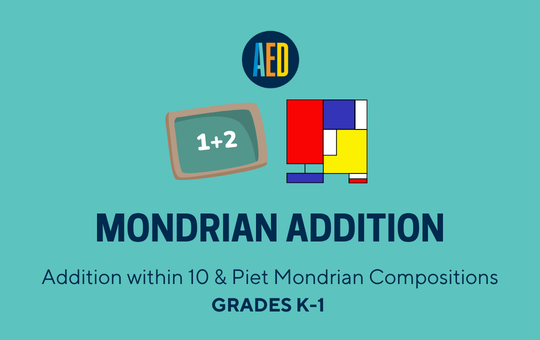
Mondrian Addition
Students will use the elements of visual art to create a composition inspired by painter Piet Mondrian that models and solves addition problems within 10, with an optional extension of adding within 20.
10-15 MinsDifferentiateGrade 1KinderMathMovement & DanceMusicSmall GroupSubtractionSubtraction Within 10
Clap. Snap. Stomp. Subtract!
Students create and perform body percussion patterns using clapping, stomping, and snapping to represent and solve subtraction equations within 10.
Animal Addition Word Problems
Students will act out “add-to” and “result unknown” animal-themed word problems to model and solve. Students will use the Read–Represent–Write routine to demonstrate their understanding and thinking.
Visual Art Addition Within 100
Students analyze a piece of jewelry by Douriean Fletcher to practice looking for groups, patterns, and quantities. Through Notice & Wonder and partner discussion, students connect what they see to strategies for adding two-digit numbers within 100.
Head Shoulders Knees Toes Place Value
Students use the familiar tune and movements of “Head, Shoulders, Knees, and Toes” to identify the place value of each digit in a multi-digit number.
Circle of Skip Counting!
Students practice skip counting while passing a clap around a circle to a steady beat. The group skip-counts by 2s, 5s, or 10s, saying one number with each clap. As students become more comfortable, increase the tempo to build fluency, listening, and automaticity.
Associative Property: Row Home Design
Students become architects designing a block of Baltimore row homes. They will sketch rows of connected row homes and use floors and windows to model the Associative Property of Multiplication.
Quilted Arrays
Students use folding to create a paper quilt to explore the Associative Property of Multiplication. Students fold their paper in different sequences to create the same number of equal sections, discovering that changing how the folds are grouped changes the process but not the total number of panels.
Multiplication DJ: Representing Factors with Rhythm
Students become “DJs” and use rhythm and movement to represent a given multiplication equation. Each student creates a short body percussion beat sequence based on the first factor, then loops that sequence according to the second factor.

