
Home ➞ Digital Resource Library ➞ ELA ➞
The Roaring Twenties (The Great Gatsby)
Arts Integrated Lesson Plans and Materials for Teaching The Great Gatsby & Odell Grade 11 “The Great Gatsby”
Roaring 20s Museum
Pairs with Odell Introduction
Students will explore materials in a Roaring 20s Museum, covering various topics that will provide background context while also deepening their comprehension and analysis of the novel.
Standards
Getting Ready
Downloads
TEACH!
Brain Connections
Creators
COMMON CORE STATE STANDARDS
- RI.11-12.1 Cite strong and thorough textual evidence to support analysis of what the text says explicitly as well as inferences drawn from the text, including determining where the text leaves matters uncertain.
- RI.11-12.7 Integrate and evaluate multiple sources of information presented in different media or formats (e.g., visually, quantitatively)as well as in words in order to address a question or solve a problem.
MARYLAND ARTS STANDARDS
- I:9-12:1: Interact effectively with others to determine factors that influenced the creation of art objects that provide social commentary in historical time and places
WHEN TO TEACH
- This activity is recommended to be facilitated prior to beginning the novel, to provide a comprehensive context for the time period the novel takes place. However, these concepts will be revisited and referenced throughout the unit, so you may use the materials how you feel best fits your class.
RESOURCES AND MATERIALS
- Primary source photographs & secondary sources for display on stations (can be found in resource material folder; labeled station 1, 2, etc)
- Art Deco Architecture
WELCOME
LEARNING DESIGN
ASSESSMENT & EVALUATION





HOW TO IMPLEMENT
Create 6 stations around the room.
-
- Display material on each station
- Station 1: 1920’s role of women
- Station 2: Art Deco architecture
- Station 3: Harlem Renaissance
- Station 4: Prohibition
- Station 5: Great Depression, WWI
- Station 6: WWI
- Material for each station can be found in the resource folder – labeled in accordance to the station topics. You can create one more station that will cover the fashion of 20’s. However, all included stations can capture the fashion at the time
- Display material on each station
Ask students (as a class) to take a look at each station
-
- Once they view all stations, divide your class into 6 small groups and assign each group to briefly summarize/present the findings of their assigned station. At this point, you can offer students a choice of topics & presentation modality (depending on your class dynamic, students, class culture etc).
- Provide each group with a primary source document analysis
- Provide students with a rubric for their group work presentation
- Once they complete the work ask groups to present findings to the whole class
- Once they view all stations, divide your class into 6 small groups and assign each group to briefly summarize/present the findings of their assigned station. At this point, you can offer students a choice of topics & presentation modality (depending on your class dynamic, students, class culture etc).
Complete the class with the summary of Roaring 20s.
BRAIN TARGETED TEACHING IN THE CLASSROOM
Overview:
Emotional Climate:
Physical Environment:
ROOT BRANCH MEDIA GROUP – BRING ROOT BRANCH TO YOUR SCHOOL!
All video content made in partnership with Baltimore’s Root Branch Media Group.
ALYSSA FENIX
Alyssa F. Fenix is a black queer neurodivergent artist, Diversity Trainer/Consultant, and founder of the “If I Knew Then Letters Project,” living in Baltimore with her partner, kids, dog, and plants. Her artistic expression includes photography, wood burning, collage art, and creative writing.
Alyssa owns Fenix OUTspoken, which is an LLC focused on diversity and inclusion practices. She uses her personal and professional experience working in education and mental health settings to provide a quality framework for clinicians and educators in supporting LGBTQ+ youth and young adults with disabilities through professional development training, Policy/Climate revisions, and coaching and consultation services. She provides a variety of professional development and training opportunities to health systems, academic institutions, and non-profit organizations about Creating Safe and Supportive spaces and practices for marginalized communities. She also works with Thrive Emerge in Maryland, providing vocational readiness and executive function coaching to neurodivergent teens and adults.
When she’s not creating or running the business, she’s hiking, propagating plants, making jewelry, or extreme puzzling
VESNA GRUJICIC
Vesna Grujicic has been an educator for over 15 years. She has started her professional journey at Baltimore City public schools and continued it at Sheppard Pratt schools. Vesna is involved in educational research focusing of project-based learning and students with special needs. She has been presenter and various conferences and professional developments. Vesna holds BA & JD degree from Belgrade University, Serbia; MA degree from Towson University; and is currently a Ph.D. candidate at Notre Dame University of Maryland Department of Education. Vesna holds MD advanced professional certificate in Social Studies, special education, and Administrator I & II.
Vocabulary in Color
Pairs with Odell Chapter 1
After looking at the word and paraphrasing the definition for their vocabulary log, students will be assigning a color to each based on what type of tone or meaning that word conveys and its symbolism.
Standards
Getting Ready
Downloads
TEACH!
Brain Connections
Creators
COMMON CORE STATE STANDARDS
- RI.11-12.1 Cite strong and thorough textual evidence to support analysis of what the text says explicitly as well as inferences drawn from the text, including determining where the text leaves matters uncertain.
- RI.11-12.7 Integrate and evaluate multiple sources of information presented in different media or formats (e.g., visually, quantitatively)as well as in words in order to address a question or solve a problem.
MARYLAND ARTS STANDARDS
- I:9-12:1: Interact effectively with others to determine factors that influenced the creation of art objects that provide social commentary in historical time and places
WHEN TO TEACH
- We recommend using this activity following the 1920 museum activity. However, it could be introduced in other chapters or various points throughout the unit.
RESOURCES AND MATERIALS
- Color Wheel
- Optional Variations of Color Reference– “Colors & Emotions” and “Psychology of Color”
- Vocabulary List and Definitions (found in O’Dell Curriculum resources)
- Graphic organizer
WELCOME
LEARNING DESIGN
ASSESSMENT & EVALUATION
HOW TO IMPLEMENT
There are a few different variations of the color wheel that are available to you. You may use whichever one you feel would be most appropriate for your class.
-
- Provide students with a graphic organizer that includes chapter vocabulary words. If you choose to expand beyond the vocabulary identified in the curriculum, you could have the students also do this with unfamiliar words they come across as they read, in which case you could use the blank template of the organizer.
- Ask students to define words according to their understanding of a word (avoid copy/paste from a dictionary)
- Once they define the word ask them to complete the section that is associating that word with a color of their choice
- Upon completing this graphic organizer, provide students with a color wheel and go through it as a class. Identify the symbolism of colors
- Now ask students to go back to the original graphic organizer and identify symbolism of colors they chose; Ask them would they change anything based on gained knowledge about color symbolism
EXTENSION
This activity can be extended by additional enrichment activity – Theory of Colors. The book we recommend isn’t free, but it could be found as an ebook in the local libraries.
Students can be provided with an additional reading about color/color of their choice.
BRAIN TARGETED TEACHING IN THE CLASSROOM
Overview:
Emotional Climate:
Physical Environment:
ROOT BRANCH MEDIA GROUP – BRING ROOT BRANCH TO YOUR SCHOOL!
All video content made in partnership with Baltimore’s Root Branch Media Group.
ALYSSA FENIX
Alyssa F. Fenix is a black queer neurodivergent artist, Diversity Trainer/Consultant, and founder of the “If I Knew Then Letters Project,” living in Baltimore with her partner, kids, dog, and plants. Her artistic expression includes photography, wood burning, collage art, and creative writing.
Alyssa owns Fenix OUTspoken, which is an LLC focused on diversity and inclusion practices. She uses her personal and professional experience working in education and mental health settings to provide a quality framework for clinicians and educators in supporting LGBTQ+ youth and young adults with disabilities through professional development training, Policy/Climate revisions, and coaching and consultation services. She provides a variety of professional development and training opportunities to health systems, academic institutions, and non-profit organizations about Creating Safe and Supportive spaces and practices for marginalized communities. She also works with Thrive Emerge in Maryland, providing vocational readiness and executive function coaching to neurodivergent teens and adults.
When she’s not creating or running the business, she’s hiking, propagating plants, making jewelry, or extreme puzzling
VESNA GRUJICIC
Vesna Grujicic has been an educator for over 15 years. She has started her professional journey at Baltimore City public schools and continued it at Sheppard Pratt schools. Vesna is involved in educational research focusing of project-based learning and students with special needs. She has been presenter and various conferences and professional developments. Vesna holds BA & JD degree from Belgrade University, Serbia; MA degree from Towson University; and is currently a Ph.D. candidate at Notre Dame University of Maryland Department of Education. Vesna holds MD advanced professional certificate in Social Studies, special education, and Administrator I & II.
Costume Design
Pairs with Odell Chapter 2
Students will pick a character from the provided list and design a costume based on what they’ve learned about them so far in both historic fashion and contemporary fashion.
Standards
Getting Ready
Downloads
TEACH!
Brain Connections
Creators
COMMON CORE STATE STANDARDS
- RI.11-12.7 Integrate and evaluate multiple sources of information presented in different media or formats (e.g., visually, quantitatively) as well as in words in order to address a question or solve a problem
MARYLAND ARTS STANDARDS
- I:9-12:1: Apply historical and cultural context of societal and theatrical conventions to analyze artistic choices and intent.
- I:9-12:1: Develop and justify personal aesthetics and artistic point of view.
- E:9-12:3: Reason effectively and communicate clearly the relationship between art and life.
WHEN TO TEACH
- This activity can be used during/immediately following reading Chapter 2, since the characters used in the activity are introduced by this point in the story. It also can be used during the rest of the novel if there is a time when it’d better suit your unit timeline.
RESOURCES AND MATERIALS
- Character List
- Assignment Template
- WATCH: Ruth E. Carter explains costume choices in Black Panther
- WATCH: Costumes define characters
WELCOME
LEARNING DESIGN
ASSESSMENT & EVALUATION
HOW TO IMPLEMENT
1. Revisit or review any fashion content shared in the Roaring 20’s video and/or the museum activity, to reiterate the fashion that aligned with the time period of the novel.
2. Using the partially completed example that you created through the course of the module, walk the students through all three parts:
-
- Character Profile/Analysis- options
- Open Ended- General concept map or list with a minimum number of details to include (set by the teacher) This would be easiest to use with the blank folded paper option.
- Template- Pre-determined outline with specific categories/sections you want them to fill in. The sample template provided would be more conducive to this format.
- 20’s Costume
- Contemporary Costume
- Character Profile/Analysis- options
3. After they’ve read the chapter and have been introduced to all of the characters, students will go through the entire process as well:
-
- Have them select a character from the list below that they will focus on for this activity. If you decide to have them work in collaborative groups for the entire unit, have each student in the group select separate characters. Suggest that this will support their culminating end of book project.
- Provide them with either copies of the template or hand out blank paper and have them fold it into 3 sections (fold as if it were a letter) and give the opportunity to complete the analysis based on supporting details from the text as well as any relevant details suggested during any class discussions about the novel.
- Once they have finished the first portion, they will begin to design the costume that they envision their chosen character to wear during the 1920’s, including supporting details for the choices/selections they use
- Have them share their completed portions with either a partner or small group, and incorporate any suggestions or feedback their partners/group members might have.
- Have them complete the last portion of the activity by designing (using drawing/sketching techniques and color pencils) a costume for their character that would align with modern day times, complete with explanations for the costume piece choices.
GUIDING QUESTIONS
Open ended questions/details students might want to use to guide their costume design decisions:
-
- What is the character’s physical appearance, personality, and background?
- What are the conflicts the character experiences and how did he/she overcome them?
- What can we learn from this character?
- What is the meaning behind the character’s actions? What motivates him/her?
- What does the character do? How does he/she treat others? Is he/she fair or unjust?
- What does the character say? What is his/her choice of words? Does he/she have a rich vocabulary?
- How does the character describe themself? How do others describe him/her?
- What words do you associate with the character? Perhaps a word like “hope”, “bravery”, or maybe even “freedom”?
BRAIN TARGETED TEACHING IN THE CLASSROOM
Overview:
Emotional Climate:
Physical Environment:
ROOT BRANCH MEDIA GROUP – BRING ROOT BRANCH TO YOUR SCHOOL!
All video content made in partnership with Baltimore’s Root Branch Media Group.
ALYSSA FENIX
Alyssa F. Fenix is a black queer neurodivergent artist, Diversity Trainer/Consultant, and founder of the “If I Knew Then Letters Project,” living in Baltimore with her partner, kids, dog, and plants. Her artistic expression includes photography, wood burning, collage art, and creative writing.
Alyssa owns Fenix OUTspoken, which is an LLC focused on diversity and inclusion practices. She uses her personal and professional experience working in education and mental health settings to provide a quality framework for clinicians and educators in supporting LGBTQ+ youth and young adults with disabilities through professional development training, Policy/Climate revisions, and coaching and consultation services. She provides a variety of professional development and training opportunities to health systems, academic institutions, and non-profit organizations about Creating Safe and Supportive spaces and practices for marginalized communities. She also works with Thrive Emerge in Maryland, providing vocational readiness and executive function coaching to neurodivergent teens and adults.
When she’s not creating or running the business, she’s hiking, propagating plants, making jewelry, or extreme puzzling
VESNA GRUJICIC
Vesna Grujicic has been an educator for over 15 years. She has started her professional journey at Baltimore City public schools and continued it at Sheppard Pratt schools. Vesna is involved in educational research focusing of project-based learning and students with special needs. She has been presenter and various conferences and professional developments. Vesna holds BA & JD degree from Belgrade University, Serbia; MA degree from Towson University; and is currently a Ph.D. candidate at Notre Dame University of Maryland Department of Education. Vesna holds MD advanced professional certificate in Social Studies, special education, and Administrator I & II.
Art Analysis
Pairs with Odell Chapter 3
This activity is designed to support students’ understanding of Symbolism and Imagery through a visual art analysis as students identify similar symbolism used in art of that time period.
Standards
Getting Ready
Downloads
TEACH!
Brain Connections
Creators
COMMON CORE STATE STANDARDS
- RL.11-12.4 Determine the meaning of words and phrases as they are used in the text, including figurative and connotative meanings; analyze the impact of specific word choices on meaning and tone, including words with multiple meanings or language that is particularly fresh, engaging, or beautiful. (Include Shakespeare as well as other authors.
- RL.11-12.9 Demonstrate knowledge of eighteenth-, nineteenth- and early-twentieth-century foundational works of American literature, including how two or more texts from the same period treat similar themes or topics.
MARYLAND ARTS STANDARDS
- I:9-12:1: Interact effectively with others to determine factors that influenced the creation of art objects that provide social commentary in historical time and places
- I:9-12:1: Make judgments and decisions by accessing, evaluating and using information from a variety of sources.
- E:9-12:1: Hypothesize ways visual imagery influences perceptions or affects human experience.
WHEN TO TEACH
- This activity would best be used following Chapter 3, as the key symbols in the novel have been introduced and the story has started to unfold further to give those symbols more meaning. However, because Symbolism and Imagery are key literary elements used throughout the novel, this activity can be implemented at other points in the unit as best fit with your class.
RESOURCES AND MATERIALS
- Visual Art Analysis Notes and Visual Art Analysis Template
- Selected Art Choices
- Symbolism Fact Sheet
- Color Wheel (found in Vocabulary in Color)
- Extension Resource
WELCOME
LEARNING DESIGN
ASSESSMENT & EVALUATION
HOW TO IMPLEMENT
Review the concept of symbolism
Display 6 book covers
-
- Divide the class into 6 small groups ( the number of groups will depend on a class size)
- Assign one book cover to each group and ask them to analyze it by using the art analysis worksheet
- Ask each group to present their analysis to the class
- Divide the class into 6 small groups ( the number of groups will depend on a class size)
Now display all six covers again, and ask the class to find prominent recurring symbols, discuss as a class what those mean in the context of the story so far (this is the activity that can be done as a whole class discussion). You can write down ( on the board or poster) all common symbols that students are pointing to.
BRAIN TARGETED TEACHING IN THE CLASSROOM
Overview:
Emotional Climate:
Physical Environment:
ROOT BRANCH MEDIA GROUP – BRING ROOT BRANCH TO YOUR SCHOOL!
All video content made in partnership with Baltimore’s Root Branch Media Group.
ALYSSA FENIX
Alyssa F. Fenix is a black queer neurodivergent artist, Diversity Trainer/Consultant, and founder of the “If I Knew Then Letters Project,” living in Baltimore with her partner, kids, dog, and plants. Her artistic expression includes photography, wood burning, collage art, and creative writing.
Alyssa owns Fenix OUTspoken, which is an LLC focused on diversity and inclusion practices. She uses her personal and professional experience working in education and mental health settings to provide a quality framework for clinicians and educators in supporting LGBTQ+ youth and young adults with disabilities through professional development training, Policy/Climate revisions, and coaching and consultation services. She provides a variety of professional development and training opportunities to health systems, academic institutions, and non-profit organizations about Creating Safe and Supportive spaces and practices for marginalized communities. She also works with Thrive Emerge in Maryland, providing vocational readiness and executive function coaching to neurodivergent teens and adults.
When she’s not creating or running the business, she’s hiking, propagating plants, making jewelry, or extreme puzzling
VESNA GRUJICIC
Vesna Grujicic has been an educator for over 15 years. She has started her professional journey at Baltimore City public schools and continued it at Sheppard Pratt schools. Vesna is involved in educational research focusing of project-based learning and students with special needs. She has been presenter and various conferences and professional developments. Vesna holds BA & JD degree from Belgrade University, Serbia; MA degree from Towson University; and is currently a Ph.D. candidate at Notre Dame University of Maryland Department of Education. Vesna holds MD advanced professional certificate in Social Studies, special education, and Administrator I & II.
Soundtrack
Pairs with Odell Chapter 4
Students will identify songs that match the message/theme of a particular selection and begin to develop a custom soundtrack for a contemporary reproduction of the story.
Standards
Getting Ready
Downloads
TEACH!
Brain Connections
Creators
COMMON CORE STATE STANDARDS
- RL.11-12.1 – Cite strong and thorough textual evidence to support analysis of what the text says explicitly as well as inferences drawn from the text.
- RL.11-12.2 – Determine a theme or central idea of a text and analyze in detail its development over the course of the text, including how it emerges and is shaped and refined by specific details; provide an objective summary.*
- RL.11-12.3 – Analyze how complex characters (e.g., those with multiple or conflicting motivations) develop over the course of a text, interact with other characters, and advance the plot or develop the theme. W.9-10.9 Draw evidence from literary or informational texts to support analysis.
MARYLAND ARTS STANDARDS
- I:9-12:1: Use research and self-developed criteria to justify choices made when selecting music, citing knowledge of the music including its purpose and context.
- I:9-12:2: Describe how the analysis of structures and contexts (social, cultural, and historical) inform the response to a variety of music selected for study.
- E:9-12:2: Analyze and respond to music through personal interpretation, justifying musical choices by defining and defending creative intent.
WHEN TO TEACH
- This activity is best used in the context and duration of Chapter 4, as the students explore themes and messages, however it can be used in any sequence in which topics such as the American Dream is referenced.
RESOURCES AND MATERIALS
- Think of technology that is available for students to produce their playlist; most students are familiar with music apps
- What musical resources are available within school ?
- Can the school library be a good resource?
- Graphic Organizer for Characterization
WELCOME
LEARNING DESIGN
ASSESSMENT & EVALUATION
INTRODUCTION
You can start this lesson by writing different themes/concepts/characters (it could be something that you already covered in previous units, or from Great Gatsby) on poster paper that you can place around the room. This can be “ gallery walk” activity or you can project individual slides allowing time for students to respond to them
-
- Ask students to write a song that might correspondent to that theme ( based on their own knowledge of music)
- If time permits, ask students to briefly explain ( or write few descriptive words, adjectives) why they have chosen a specific song
MODEL
Now, you can select one of students songs or you might prepare your own song to model analysis of HOW the music (tone, rhythm, tempo) vocals, instrumentalization, lyrics help convey a certain tone, emotion, message that aligns with the theme/character
ACTIVITY
Have students complete their graphic organizers with songs selection
-
- Once students complete the graphic organizers, the additional reflection activity based on two questions can be provided to students:
What similarities and/or differences have you found between analyzing a literary text and analyzing a song?
How has the process of selecting and analyzing songs for your playlist helped your deeper understanding of the literary text?
BRAIN TARGETED TEACHING IN THE CLASSROOM
Overview:
Emotional Climate:
Physical Environment:
ROOT BRANCH MEDIA GROUP – BRING ROOT BRANCH TO YOUR SCHOOL!
All video content made in partnership with Baltimore’s Root Branch Media Group.
ALYSSA FENIX
Alyssa F. Fenix is a black queer neurodivergent artist, Diversity Trainer/Consultant, and founder of the “If I Knew Then Letters Project,” living in Baltimore with her partner, kids, dog, and plants. Her artistic expression includes photography, wood burning, collage art, and creative writing.
Alyssa owns Fenix OUTspoken, which is an LLC focused on diversity and inclusion practices. She uses her personal and professional experience working in education and mental health settings to provide a quality framework for clinicians and educators in supporting LGBTQ+ youth and young adults with disabilities through professional development training, Policy/Climate revisions, and coaching and consultation services. She provides a variety of professional development and training opportunities to health systems, academic institutions, and non-profit organizations about Creating Safe and Supportive spaces and practices for marginalized communities. She also works with Thrive Emerge in Maryland, providing vocational readiness and executive function coaching to neurodivergent teens and adults.
When she’s not creating or running the business, she’s hiking, propagating plants, making jewelry, or extreme puzzling
VESNA GRUJICIC
Vesna Grujicic has been an educator for over 15 years. She has started her professional journey at Baltimore City public schools and continued it at Sheppard Pratt schools. Vesna is involved in educational research focusing of project-based learning and students with special needs. She has been presenter and various conferences and professional developments. Vesna holds BA & JD degree from Belgrade University, Serbia; MA degree from Towson University; and is currently a Ph.D. candidate at Notre Dame University of Maryland Department of Education. Vesna holds MD advanced professional certificate in Social Studies, special education, and Administrator I & II.
Tableau
Pairs with Odell Chapter 5
Students will be asked to reenact scenes from this chapter by posing themselves or posing their classmates based on the descriptive language from the novel.
Standards
Getting Ready
Downloads
TEACH!
Brain Connections
Creators
COMMON CORE STATE STANDARDS
- RL.11-12.1 – Cite strong and thorough textual evidence to support analysis of what the text says explicitly as well as inferences drawn from the text, including determining where the text leaves matters uncertain.
- RL.11-12.3 – Analyze the impact of the author’s choices regarding how to develop and relate elements of a story or drama (e.g., where a story is set, how the action is ordered, how the characters are introduced and developed).
MARYLAND ARTS STANDARDS
- I:9-12:2: Apply a variety of researched acting, vocal, and movement techniques, to create convincing character choices.
WHEN TO TEACH
- This activity can be used during/immediately following reading Chapter 5, since the scenes in Chapter 5 use such imagery related to body language that would support students’ understanding of the relationship between the characters. It can be used alternatively during other parts of the novel if that suits your class timeline.
RESOURCES AND MATERIALS
WELCOME
LEARNING DESIGN
ASSESSMENT & EVALUATION
HOW TO IMPLEMENT
At the beginning of the class, it’s always a good idea to review previously learned content or skills addressed.
This activity is best facilitated after the students have had a chance to read Chapter 5 so as a class the referenced passages will be familiar and easier to analyze and apply the Arts Integrated skill to. If you’re reading and discussing the text as a class, make sure discussion points pause at the passages outlined for this activity, so that when you introduce the activity, they will be more familiar with and understand those portions more clearly.
Teaching the “Tableau” Strategy for understanding text:
-
- Hand out the Theater and Drama Resource sheet and have them look it over, and ask them to make predictions for today’s lessons on how it connects to this portion of the novel.
- Ask them to look at the section titled “Tableau” and after reviewing the definition with them, have students generate ideas how Tableau could enhance their understanding of the novel. You can guide them towards some answers such as:
- It helps reinforce memory of the events by providing a memory to recall
- Extension idea: discuss neurodiversity in the sense that individuals brains vary in how they generate images that are described to them. Brains that don’t generate images (known as Aphantasia) and they especially benefit from having text reenacted for easier recall and comprehension
- Exemplifies value of descriptive language and imagery used
- Adds dimension to characters when they have the chance to experience their movements
- Fosters appreciation of another art form, and further explore personal interest in the arts
- Can be another avenue of expression, especially for individuals that learn best through movement
- It helps reinforce memory of the events by providing a memory to recall
Tell them you are going to give them a scenario that they would have to “act out” at their desks (or near their desks, depending on class size and space available). Give them 2-3 of the scenarios listed below, using the cue “Action 2-3-Freeze” each time. After each pose, ask them to look around and take note of their classmates’ poses. You may reference tiktok trends that prompt users to make facial expressions based on randomly generated phrase. Tell them they must hold the pose until you give the verbal direction“relax”
-
- You’re presented with an award at a public event
- You trip in the middle of a championship game
- You found out you failed a quiz that you were confident they aced
- You spill water on yourself before getting up to make a presentation
- Your crush tells you they like your best friend
Ask them first to share what types of feelings were expressed, and explain that the job of actors is to first think about what emotion and movement through their body language and gestures that would communicate that emotion. Then have them share some qualities of one anothers’ poses that they liked and enhanced the scenario described.
-
- Write these on the board, and try to guide them towards some of the following words/phrases, and explain that these are the types of things they want to consider and use when engaging in Tableau
- Staying frozen
- Staying Silent
- Posing with energy
- Using a lot of expression
- Express a particular emotion or mood
- Use the space available to them
- Use varied body language/gestures
- Write these on the board, and try to guide them towards some of the following words/phrases, and explain that these are the types of things they want to consider and use when engaging in Tableau
Now, have a student or two volunteer to act out a new scenario of their choosing, and have their peers guess what’s happening/how they’re feeling in the scenario. Next have 2-3 students act out scenarios together, using the same procedure of having the class share what they observe.
Have the students go through a couple of scenarios in which they actually change their pose within a few seconds of their initial freeze frame, repeating “Action, 2, 3, Freeze.” You may use some of the sample scenarios below:
-
- You see an old friend walk into the same cafe that you’re at and try to get their attention (Pose) Action , 2, 3… Freeze —–> You suddenly realize that it’s not your friend after all (Pose)
- You’re presented with an award that you weren’t expecting (Pose) Action, 2, 3, Freeze —–> You trip on your way to the stage (Pose)
- You’re telling your bestfriend that really upset because it feels like everyone’s forgotten your birthday (Pose) Action, 2, 3, Freeze —–> Just then, several friends jump up and surprise you screaming happy birthday
- You’re venting about your obnoxious supervisor at work by text, and include a screen shot of your convo with them. (Pose) Action, 2, 3, Freeze ——> You suddenly realize you sent it to the supervisor instead of your friend
Explain that if they were to do this in pairs or a small group, they would have to do some planning for both poses. Explain that they will be doing that today with their assigned groups, using passages from Chapter 5 in the novel.
Direct the students to get into their assigned groups for the unit, and have them reenact their assigned passages. Depending on the size of their groups, you may want to provide the suggestion of taking turns being the actors (posing) the directors (offering feedback on their poses), and the narrator (reading the passage out)
In order of the scenes occurrence in the novel, have the corresponding groups present their Tableau to the rest of the class”
-
- This would be a good opportunity to introduce the practice of offering “Glows and Grows” as a method of offering feedback, and having them explicitly reference/comment on the traits of a quality Tableau that the class brainstormed earlier
- Glows- positive feedback of things they liked about the presented Tableau
- Grows- constructive suggestions for ways to enhance the presented Tableau
- Based on the Glows and Grows provided by their classmates, you may have the students work on their passage again and incorporate the feedback they received. This reinforces an essential skill in education of being able to revise work using feedback
- This would be a good opportunity to introduce the practice of offering “Glows and Grows” as a method of offering feedback, and having them explicitly reference/comment on the traits of a quality Tableau that the class brainstormed earlier
Formative Assessment or closing activity: As an exit ticket or a journal reflection, have the students answer the following question:
How can the skills addressed in this activity be applicable outside of the classroom?
BRAIN TARGETED TEACHING IN THE CLASSROOM
Overview:
Emotional Climate:
Physical Environment:
ROOT BRANCH MEDIA GROUP – BRING ROOT BRANCH TO YOUR SCHOOL!
All video content made in partnership with Baltimore’s Root Branch Media Group.
ALYSSA FENIX
Alyssa F. Fenix is a black queer neurodivergent artist, Diversity Trainer/Consultant, and founder of the “If I Knew Then Letters Project,” living in Baltimore with her partner, kids, dog, and plants. Her artistic expression includes photography, wood burning, collage art, and creative writing.
Alyssa owns Fenix OUTspoken, which is an LLC focused on diversity and inclusion practices. She uses her personal and professional experience working in education and mental health settings to provide a quality framework for clinicians and educators in supporting LGBTQ+ youth and young adults with disabilities through professional development training, Policy/Climate revisions, and coaching and consultation services. She provides a variety of professional development and training opportunities to health systems, academic institutions, and non-profit organizations about Creating Safe and Supportive spaces and practices for marginalized communities. She also works with Thrive Emerge in Maryland, providing vocational readiness and executive function coaching to neurodivergent teens and adults.
When she’s not creating or running the business, she’s hiking, propagating plants, making jewelry, or extreme puzzling
VESNA GRUJICIC
Vesna Grujicic has been an educator for over 15 years. She has started her professional journey at Baltimore City public schools and continued it at Sheppard Pratt schools. Vesna is involved in educational research focusing of project-based learning and students with special needs. She has been presenter and various conferences and professional developments. Vesna holds BA & JD degree from Belgrade University, Serbia; MA degree from Towson University; and is currently a Ph.D. candidate at Notre Dame University of Maryland Department of Education. Vesna holds MD advanced professional certificate in Social Studies, special education, and Administrator I & II.
Filming Techniques
Pairs with Odell Chapter 6
After identifying themes they have read, students will pair quotes from Chapter 6 with filming techniques and camera angles to depict recurring themes.
Standards
Getting Ready
Downloads
TEACH!
Brain Connections
Creators
COMMON CORE STATE STANDARDS
- RL.11-12.2 – Determine two or more themes or central ideas of a text and analyze their development over the course of the text, including how they interact and build on one another to produce a complex account; provide an objective summary of the text.
- RL.11-12.1 – Cite strong and thorough textual evidence to support analysis of what the text says explicitly as well as inferences drawn from the text, including determining where the text leaves matters uncertain.
MARYLAND ARTS STANDARDS
- I:9-12:1: Demonstrate and explain how media artworks and ideas relate to various contexts, purposes and values in society.
- I:9-12:1: Demonstrate and employ artistic, design, technical, and soft skills in managing and producing media artworks.
WHEN TO TEACH
- While themes are a topic that could be addressed throughout the novel, there are some powerful quotes and references to themes in Chapter 6 that would lend themselves to this activity. It is also helpful to be addressing filming skills and concepts in the second half of the novel as the students get closer to their final project.
RESOURCES AND MATERIALS
- Film Techniques Resource Sheet
- Additional Camera Angle/Shots Resources
- “Picture This” Worksheet Templates
WELCOME
LEARNING DESIGN
ASSESSMENT & EVALUATION
HOW TO IMPLEMENT
Review what happened in Chapter 6, if the students have read it prior to this activity. This activity can also be done as a class and done as you’re reading the book as a whole group, with intentional pauses for certain passages (some passage examples have been provided to you, but you may choose to use passages that the students select based on their questions or expressed interests)
-
- Add to the themes concept map based on any new themes or messages they’ve encountered since the last activity emphasizing theme is.
- Revisit the concept of symbolism, prompting them with examples from the novel, and discussing what they mean. For example: “When Fitzgerald references the green light, what types of feelings or messages come to mind?” This is the opportunity to bridge the concept of themes and literary devices, and similarly bringing their attention to the idea that visual cues can prompt us to draw upon previous interpretations or inferences from the text
As a class, have them view this Youtube video. This breaks down how to use cinematic techniques to tell stories, which is what you want them to get out of this lesson.
-
- Ask students to think of their favorite scene from their favorite movie and if they’re able to visualize it (or if you have time to allow them to look the scenes up on their phones or computers in small groups), ask if they can identify the camera angle or movement that is used.
- Using the reference/resource sheets you provided them, ask them if they felt like the camera angle used appropriately aligned to the point, purpose, message of that particular scene. Ask them to share their scenes in their groups or with a partner, and talk about whether the camera angle/shot/movement enhanced or detracted from the significance of that particular scene. Have some students share their examples and leading a brief discussion with their class about the use in that scene would be a good way to make sure everyone is clear on the objective.
- Ask students to think of their favorite scene from their favorite movie and if they’re able to visualize it (or if you have time to allow them to look the scenes up on their phones or computers in small groups), ask if they can identify the camera angle or movement that is used.
You also may further scaffold this activity by providing a few scenes from popular movies that use a variety of cinematic techniques to depict themes, or even prompting them with some basic examples such as:
-
- What camera angle would you use when featuring a bully who is presented as intimidating?
- What camera angle might you use to show that someone’s nervously fidgeting?
- What camera would you use to show that someone is truly enamored with another person without the other person knowing it?
For the next activity, they can work individually or in groups to identify passages in Chapter 6 that carried meaning or directly tied with some of the themes identified on the concept map, and have them use their resources to imagine they were the producer and identify what type of Camera shot they would use to really emphasize the theme of that particular scene, and a brief explanation as to why..
-
- Some passages have been provided to you as examples, but you may use the blank version of the template to have students fill in their own based on passages that they felt most drawn to in that chapter.
DIFFERENTIATION
This activity may be differentiated based on the complexity of the passages assigned to them (if you decide to provide them specific passages) or you may ask students to complete a certain number of them to demonstrate mastery.
BRAIN TARGETED TEACHING IN THE CLASSROOM
Overview:
Emotional Climate:
Physical Environment:
ROOT BRANCH MEDIA GROUP – BRING ROOT BRANCH TO YOUR SCHOOL!
All video content made in partnership with Baltimore’s Root Branch Media Group.
ALYSSA FENIX
Alyssa F. Fenix is a black queer neurodivergent artist, Diversity Trainer/Consultant, and founder of the “If I Knew Then Letters Project,” living in Baltimore with her partner, kids, dog, and plants. Her artistic expression includes photography, wood burning, collage art, and creative writing.
Alyssa owns Fenix OUTspoken, which is an LLC focused on diversity and inclusion practices. She uses her personal and professional experience working in education and mental health settings to provide a quality framework for clinicians and educators in supporting LGBTQ+ youth and young adults with disabilities through professional development training, Policy/Climate revisions, and coaching and consultation services. She provides a variety of professional development and training opportunities to health systems, academic institutions, and non-profit organizations about Creating Safe and Supportive spaces and practices for marginalized communities. She also works with Thrive Emerge in Maryland, providing vocational readiness and executive function coaching to neurodivergent teens and adults.
When she’s not creating or running the business, she’s hiking, propagating plants, making jewelry, or extreme puzzling
VESNA GRUJICIC
Vesna Grujicic has been an educator for over 15 years. She has started her professional journey at Baltimore City public schools and continued it at Sheppard Pratt schools. Vesna is involved in educational research focusing of project-based learning and students with special needs. She has been presenter and various conferences and professional developments. Vesna holds BA & JD degree from Belgrade University, Serbia; MA degree from Towson University; and is currently a Ph.D. candidate at Notre Dame University of Maryland Department of Education. Vesna holds MD advanced professional certificate in Social Studies, special education, and Administrator I & II.
Screenplay
Pairs with Odell Chapter 7
After discussing language specific to certain time periods, students will translate the chapter’s dialogue into contemporary terminology, in the form of a screenplay or script for the chapter.
Standards
Getting Ready
Downloads
TEACH!
Brain Connections
Creators
COMMON CORE STATE STANDARDS
- W.11-12.3 – Write narratives to develop real or imagined experiences or events using effective technique, well-chosen details, and well structured event sequences.
- W.11-12.3.b – Use narrative techniques, such as dialogue, pacing, description, reflection, and multiple plot lines, to develop experiences, events, and/or characters.
MARYLAND ARTS STANDARDS
- I:9-12:1: Demonstrate and explain how media artworks and ideas relate to various contexts, purposes and values in society.
- I:9-12:1: Demonstrate and employ artistic, design, technical, and soft skills in managing and producing media artworks.
WHEN TO TEACH
- This activity is designed to be used immediately following the students’ reading Chapter 7.
RESOURCES AND MATERIALS
- Film Techniques Resource Sheet
- 1920’s Slang Handout
- Optional Supplemental texts about dialogue
WELCOME
LEARNING DESIGN
ASSESSMENT & EVALUATION
PART ONE
Start out reviewing the chapter’s summary and key points and perhaps take this opportunity to review any new vocabulary (especially any words encountered in Chapter 7’s rich dialogue)
As an attention grabbing activity, hand out the 1920’s slang hand out and have them translate some of the statements as best (and appropriately) as they can. What would certain phrases sound like today?
-
- Then facilitate a brief class discussion on how language is used differently than in the 1920’s. Is the terminology more complex in one era? Is it more descriptive? Harsher sounding? For extra credit or just for fun, you could encourage them to use some of the phrases (minus the insults) throughout the rest of the duration of the unit.
Introduce the idea of language and using dialogue to change the meaning of situations.
Part #1) There is a sample activity below, in which they have to translate the connotation or emotional charge of specific quotes, and put them in more direct terms. You may do this as a class or small groups, having the students pick their favorite passages to “Translate” from earlier chapters. Modify it with as much or little prompts or quotes as you feel would be appropriate for your class.

PART TWO
Part #2) Then there are some instances where they must come up with an original quote or statement that could be used in dialogue that would convey the feeling or meaning specified. This may be done using stage directions as well or indicated movements
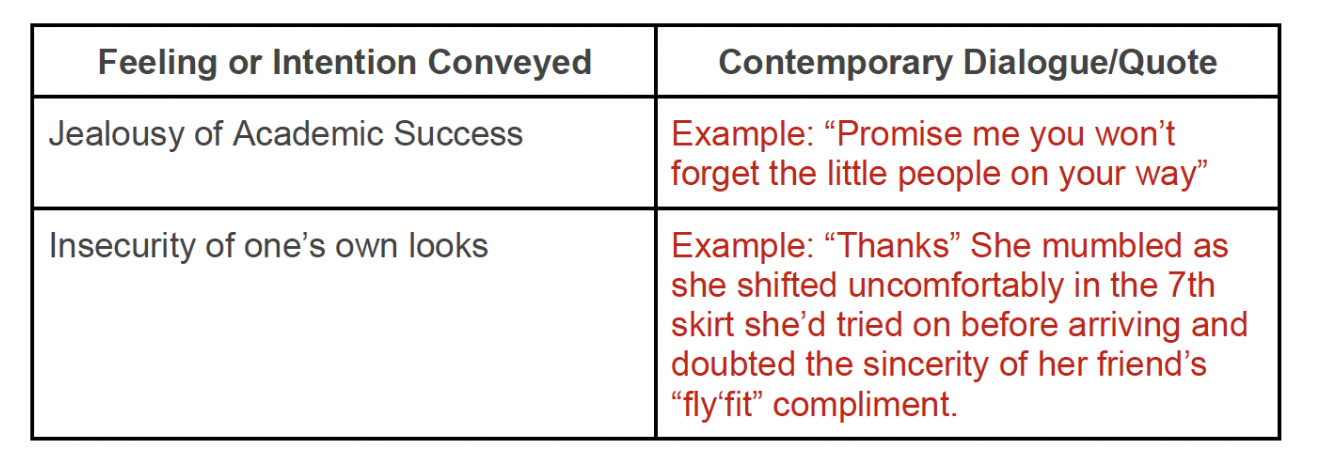
PART THREE
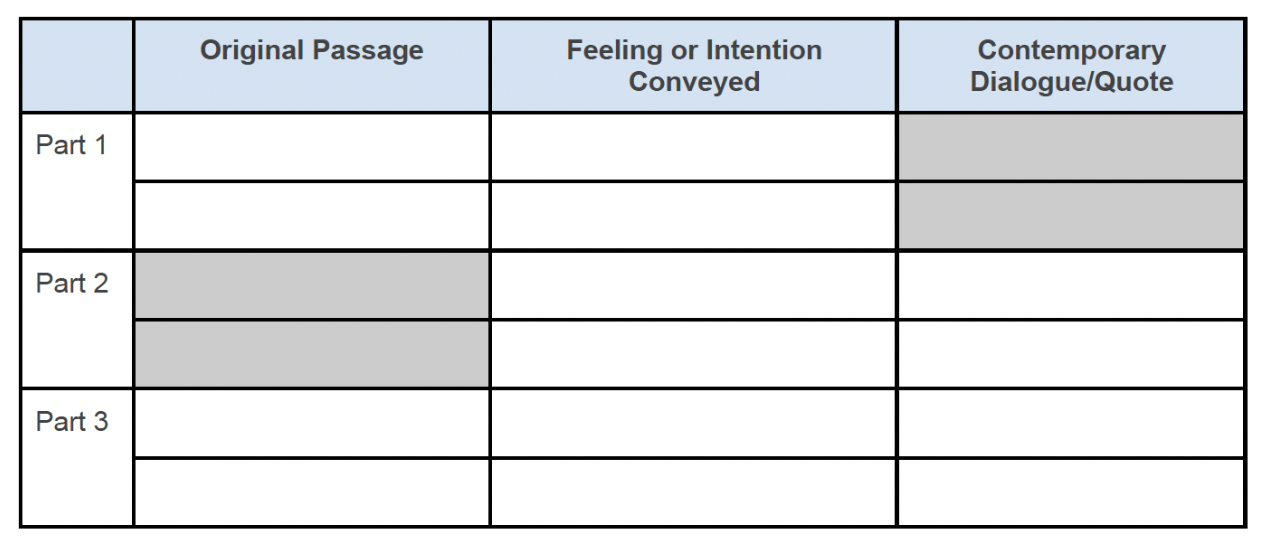
Part #3) The last chart involves all three components as a progression and this will help build up to the desired objective of creating a contemporary version of the script for specific passages from the chapter. You may even want to use this 3 column chart for all steps and just shade or cross out the boxes that you’re not looking for responses in. See below for examples.
TIPS
The articles referenced in the Resources box are OPTIONAL and could be used in a socratic format in which students are assigned sections to read and then share out with the class. In either case, you want to touch on key concepts
Writing Dialogue Tips:
-
- Increase Conflict through Contradiction (how characters communicate or approach conflict reveals a lot about them and often builds mystery/suspense in connection to the plot)
- Example: ‘What’ll we do with ourselves this afternoon,’ cried Daisy, ‘and the day after that, and the next thirty years?’ ‘Don’t be morbid,’ Jordan said. ‘Life starts all over again when it gets crisp in the fall.’
- Avoid Dialogue that is “On the nose” (Aka directly stated or obvious)
- Example: ‘Who wants to go to town?’ demanded Daisy insistently. Gatsby’s eyes floated toward her. ‘Ah,’ she cried, ‘you look so cool.’ Their eyes met, and they stared together at each other, alone in space. With an effort she glanced down at the table. ‘You always look so cool,’ she repeated. She had told him that she loved him, and Tom Buchanan saw. He was astounded.
- Hint at the Theme of the story through shorter statements by characters (and the manner in which they express them)
- Example: ‘She’s got an indiscreet voice,’ I remarked. ‘It’s full of — ‘ I hesitated. ‘Her voice is full of money,’ he said suddenly. That was it. I’d never understood before. It was full of money — that was the inexhaustible charm that rose and fell in it, the jingle of it, the cymbals’ song of it….
- Increase Conflict through Contradiction (how characters communicate or approach conflict reveals a lot about them and often builds mystery/suspense in connection to the plot)
Now that the students have what they need to create an original script and convey intended messages, it’s their turn to try it out themselves. For the purposes of this assignment, it is recommended that the students complete the activity using the passage in which Tom Buchanan confronts Gatsby about his relationship with Daisy, and it’s possibly the easiest to understand and translate.
Reminder: Because this chapter, especially the recommended confrontation scene, is lengthy, let students know they aren’t expected recreate or rewrite the dialogue line by line, and that they might accomplish the same effect appropriate for their contemporary version by a simple stage direction
-
- Example: If the scene was showing a character reacting immaturely to someone’s accusations, the writer might have that storm off stage, slam doors, or putting their headphones in, etc.)
BRAIN TARGETED TEACHING IN THE CLASSROOM
Overview:
Emotional Climate:
Physical Environment:
ROOT BRANCH MEDIA GROUP – BRING ROOT BRANCH TO YOUR SCHOOL!
All video content made in partnership with Baltimore’s Root Branch Media Group.
ALYSSA FENIX
Alyssa F. Fenix is a black queer neurodivergent artist, Diversity Trainer/Consultant, and founder of the “If I Knew Then Letters Project,” living in Baltimore with her partner, kids, dog, and plants. Her artistic expression includes photography, wood burning, collage art, and creative writing.
Alyssa owns Fenix OUTspoken, which is an LLC focused on diversity and inclusion practices. She uses her personal and professional experience working in education and mental health settings to provide a quality framework for clinicians and educators in supporting LGBTQ+ youth and young adults with disabilities through professional development training, Policy/Climate revisions, and coaching and consultation services. She provides a variety of professional development and training opportunities to health systems, academic institutions, and non-profit organizations about Creating Safe and Supportive spaces and practices for marginalized communities. She also works with Thrive Emerge in Maryland, providing vocational readiness and executive function coaching to neurodivergent teens and adults.
When she’s not creating or running the business, she’s hiking, propagating plants, making jewelry, or extreme puzzling
VESNA GRUJICIC
Vesna Grujicic has been an educator for over 15 years. She has started her professional journey at Baltimore City public schools and continued it at Sheppard Pratt schools. Vesna is involved in educational research focusing of project-based learning and students with special needs. She has been presenter and various conferences and professional developments. Vesna holds BA & JD degree from Belgrade University, Serbia; MA degree from Towson University; and is currently a Ph.D. candidate at Notre Dame University of Maryland Department of Education. Vesna holds MD advanced professional certificate in Social Studies, special education, and Administrator I & II.
Storyboard
Pairs with Odell Chapter 8
Students are tasked with creating a storyboard of the events that take place throughout various parts of the chapter for a contemporary production of the novel, using script writing and filming techniques they’ve learned in activities prior to this point in the novel.
Standards
Getting Ready
Downloads
TEACH!
Brain Connections
Creators
COMMON CORE STATE STANDARDS
- CCSS.ELA-Literacy.W.11-12.4 – Produce clear and coherent writing in which the development, organization, and style are appropriate to task, purpose, and audience.
MARYLAND ARTS STANDARDS
- I:9-12:1: Demonstrate and explain how media artworks and ideas relate to various contexts, purposes and values in society.
- I:9-12:1: Demonstrate and employ artistic, design, technical, and soft skills in managing and producing media artworks.
WHEN TO TEACH
- The Storyboard activity is recommended for use following Chapter 8 since it’s the climax of the story. However, if you are not able to do all of the activities and would like to use this activity at another point, just make sure it follows all of the other activities before the Movie Trailer, to additionally reinforce that the storyboard is one of the final steps before any work is filmed.
RESOURCES AND MATERIALS
WELCOME
LEARNING DESIGN
ASSESSMENT & EVALUATION
HOW TO IMPLEMENT
Review the events from Chapter 8 and add to your ongoing concept map of themes and messages, since Chapters 7 and 8 both introduce this idea of revenge and manipulation through dishonesty
-
- Since you’re only one step away from the final project, see if you can generate some ideas from the class of what artistic skills they have learned/covered so far in the unit and generate ideas they still would have to learn before diving into the movie trailer assignment. They may come up with a variety of answers, and may need guidance on the answer you’re looking for, which is “Storyboards” or creating a rough draft.
- This is a new concept for many of them, so you will want to make sure you slow this part down and emphasize that it is one of the most important parts of any group project, because it is the rough draft, that makes sure that all parties involved are on the same page as to what the final product will look like.
- Using the Film Techniques Resource Sheet we’ve provided and the Youtube video ”How to draw an A-Grade storyboard” walk the students through the basics of a storyboard and reinforce the idea that this puts it all together and makes sure that the vision for all of the parties are in alignment. You will also want them to use the sample storyboard you’ve provided to see how it all comes together and what it should look like when they are done.
- This is less of a whole group instructional activity, because the resources can be made accessible to them for them to refer back to throughout the process. Also, that gives them some time to map out a very general structure or timeline for their idea for the movie trailer project. Because of that, the students will only have to create a storyboard for a specific passage, because you’ll be able to see within 2-3 steps if they understand the process.
- Give them a specific 10-15 minutes of time to spend working together towards the end of class to fill out the “Initial Planning” Handout which consists of just a few storyboard boxes and a space to write out a constructed response that describes their concept for the contemporary version of the novel. It also asks them to use the checklist to identify specific contributions that they can bring to the group’s efforts (E.G. I can use my TikTok editing skills to edit the movie clips)
- Since you’re only one step away from the final project, see if you can generate some ideas from the class of what artistic skills they have learned/covered so far in the unit and generate ideas they still would have to learn before diving into the movie trailer assignment. They may come up with a variety of answers, and may need guidance on the answer you’re looking for, which is “Storyboards” or creating a rough draft.
BRAIN TARGETED TEACHING IN THE CLASSROOM
Overview:
Emotional Climate:
Physical Environment:
ROOT BRANCH MEDIA GROUP – BRING ROOT BRANCH TO YOUR SCHOOL!
All video content made in partnership with Baltimore’s Root Branch Media Group.
ALYSSA FENIX
Alyssa F. Fenix is a black queer neurodivergent artist, Diversity Trainer/Consultant, and founder of the “If I Knew Then Letters Project,” living in Baltimore with her partner, kids, dog, and plants. Her artistic expression includes photography, wood burning, collage art, and creative writing.
Alyssa owns Fenix OUTspoken, which is an LLC focused on diversity and inclusion practices. She uses her personal and professional experience working in education and mental health settings to provide a quality framework for clinicians and educators in supporting LGBTQ+ youth and young adults with disabilities through professional development training, Policy/Climate revisions, and coaching and consultation services. She provides a variety of professional development and training opportunities to health systems, academic institutions, and non-profit organizations about Creating Safe and Supportive spaces and practices for marginalized communities. She also works with Thrive Emerge in Maryland, providing vocational readiness and executive function coaching to neurodivergent teens and adults.
When she’s not creating or running the business, she’s hiking, propagating plants, making jewelry, or extreme puzzling
VESNA GRUJICIC
Vesna Grujicic has been an educator for over 15 years. She has started her professional journey at Baltimore City public schools and continued it at Sheppard Pratt schools. Vesna is involved in educational research focusing of project-based learning and students with special needs. She has been presenter and various conferences and professional developments. Vesna holds BA & JD degree from Belgrade University, Serbia; MA degree from Towson University; and is currently a Ph.D. candidate at Notre Dame University of Maryland Department of Education. Vesna holds MD advanced professional certificate in Social Studies, special education, and Administrator I & II.
Movie Trailer
Pairs with Odell Chapter 9
Students will work in small assigned groups to create a movie trailer of a contemporary production of The Great Gatsby. This culminating project will be the synthesis of the skills acquired in the previous chapters.
Standards
Getting Ready
Downloads
TEACH!
Brain Connections
Creators
COMMON CORE STATE STANDARDS
- CCSS.ELA-Literacy.RL.11-12.3 – Analyze the impact of the author’s choices regarding how to develop and relate elements of a story or drama (e.g., where a story is set, how the action is ordered, how the characters are introduced and developed).
MARYLAND ARTS STANDARDS
- E:9-12:1: Access, evaluate, use and manage multiple types of media (video, sound, still pictures) with academic content to produce one media product that has a consistent theme.
- I:9-12:1: Apply aesthetic criteria in developing, proposing, and refining artistic ideas, project designs, prototypes, and production processes for media arts productions.
- I:9-12:1: Evaluate media art works and production processes using identified criteria.
- I:9-12:1: Demonstrate and explain how media artworks and ideas relate to various contexts, purposes and values in society.
WHEN TO TEACH
- This project is designed to be done after the students have read the full novel, either prior to or in conjunction to the curriculum lessons that follow the completion of the novel.
RESOURCES AND MATERIALS
- Rubric
- Film Techniques Resource Sheet
- Theater/ Drama Resource Sheet
- Fashion Design Resource Sheet
- Visual Arts Resource Sheet
- Journal Entry Prompt
- Project Checklist with Planning Materials
- Group Roles/Responsibilities sheet and Community Agreements
- Brainstorming Notes or Concept Map
- Character Profiles for selected at least 2 featured characters
- Copy of Screenplay
- Soundtrack songs featured (at least 1 song)
- Storyboard
- Glows and Grows Template
WELCOME
LEARNING DESIGN
ASSESSMENT & EVALUATION
PREP
Before the unit, you’ll want to consider the following. This will
-
- Number of students
- Groups can be as small as 3 but as large as 6. Just make sure you take into consideration how much support you’ll be able to offer if you decide to make more smaller groups (3-4 students) instead of making less amount of the full groups (5-6 students).
- Access to Technology
- Consider whether you’ll need access to a computer lab or other equipment that is not ready to use consistently, or have the students divide the role responsibilities in the group based on comfort and familiarity with tools needed for editing, etc. (This can include expert Social Media users, because of the experience editing videos) This is also why we recommend you intentionally group based on strengths, learning modalities, and interests.
- Time allotted in class and how much you can realistically assign students to complete outside of class. One variation is you may not actually require them to complete the filming portion, and just complete all of the steps that are needed to write and produce a movie trailer.
- Decide before the unit begins, how long approximately you have to complete the unit, while hitting the priority content standards. As you lay out your timeline, you may decide that you can’t do all of the activities, in which case you can cut certain activities short or omit them entirely. However, if you plan on doing the movie trailer project and have to omit activities, prioritize Chapter 6, 7, & 8 since they involve skills that will prepare them for creating the trailer. Be liberal with your time estimates so you don’t run out of time.
- Number of students
INTRODUCE
Show them 2-3 movie trailers, one of which is of the movie “Gatsby.” Try to pick trailers that also feature some of the components from the rubric (Soundtrack clips, costumes, symbolism, dialogue, etc.)
Have the students (either as a class or starting in small groups) brainstorm all of the common components of the trailers and make a concept map as a whole class, guiding them towards some of the components on the rubric (Either encourage students to copy the concept map in their notes, or print it out and distribute copies for them to keep).
-
- Pass the rubric out and have them compare what they see on the rubric to the ideas on the concept map, marking the ones on the rubric in a distinct way (highlighted, circled, etc.) This way they know that those marked items are requirements whereas the others are optional but could enhance their project’s quality (reinforces planning and prioritization, which is an important executive function)
PLANNING
In their Small Groups, the students…
-
- Look over the checklist and ask questions as needed
- Have them collaboratively create community agreements that they can hold themselves and one another accountable for
- Delegating Roles and Responsibilities within the group
- Exchange Contact information (if work is expected to be done outside of class time)
- Make a general timeline for working through the steps. This may be something that you decide for them so you can model chunking larger assignments (reinforcing the Executive Function of Time Management)
- At minimum, have them brainstorm on the type of contemporary version they’ll be working with. Examples that you may want to gently hint at without handing to them include but aren’t limited to: Sports themed, Gothic/Emo, Queerness, themes that center politics or contrasting belief systems, etc.).
- TIP: If a particular topic is one that’s not as familiar to you, seek support in learning how to best support the students and facilitate discussions around that topic. See our resource list for where you can find more information
Offer sufficient class time to work on the project, as well as share out ideas and ask questions among other students. This can encourage the value of seeking, accepting, and responding to feedback from others.
-
- Depending on the time you designate for them to work in class, the groups will be expected to move through the checklist as independently as possible, and seeking support from you only as needed, having them submit materials or notes on what’s done each time, for your review.
- Provide feedback as quickly as possible so that they can incorporate it into their work during the next time they meet.
- Review procedures with them for the use of any equipment if they are using any school equipment (though having them use their phones is recommended since many are familiar with the technology).
- Set a submission date for them to turn in all draft materials prior to presenting their final project.
SCREENING
During their assigned day/time slot to present their trailers, provide the class with a stack of “Glows and Grows” Feedback slips, and tell them to offer their feedback on the final product. As needed, review the difference between glows and grows and how to offer constructive feedback and quality compliments.
-
- Have students grade themselves as a group using the rubric, as well as complete a journal reflection on the project’s completion process.
- Collect the following materials: journal reflections, the group’s self grade, and a file of their completed project (all of which could be done electronically)
BRAIN TARGETED TEACHING IN THE CLASSROOM
Overview:
Emotional Climate:
Physical Environment:
ROOT BRANCH MEDIA GROUP – BRING ROOT BRANCH TO YOUR SCHOOL!
All video content made in partnership with Baltimore’s Root Branch Media Group.
ALYSSA FENIX
Alyssa F. Fenix is a black queer neurodivergent artist, Diversity Trainer/Consultant, and founder of the “If I Knew Then Letters Project,” living in Baltimore with her partner, kids, dog, and plants. Her artistic expression includes photography, wood burning, collage art, and creative writing.
Alyssa owns Fenix OUTspoken, which is an LLC focused on diversity and inclusion practices. She uses her personal and professional experience working in education and mental health settings to provide a quality framework for clinicians and educators in supporting LGBTQ+ youth and young adults with disabilities through professional development training, Policy/Climate revisions, and coaching and consultation services. She provides a variety of professional development and training opportunities to health systems, academic institutions, and non-profit organizations about Creating Safe and Supportive spaces and practices for marginalized communities. She also works with Thrive Emerge in Maryland, providing vocational readiness and executive function coaching to neurodivergent teens and adults.
When she’s not creating or running the business, she’s hiking, propagating plants, making jewelry, or extreme puzzling
VESNA GRUJICIC
Vesna Grujicic has been an educator for over 15 years. She has started her professional journey at Baltimore City public schools and continued it at Sheppard Pratt schools. Vesna is involved in educational research focusing of project-based learning and students with special needs. She has been presenter and various conferences and professional developments. Vesna holds BA & JD degree from Belgrade University, Serbia; MA degree from Towson University; and is currently a Ph.D. candidate at Notre Dame University of Maryland Department of Education. Vesna holds MD advanced professional certificate in Social Studies, special education, and Administrator I & II.
