Home ➞ Digital Resource Library ➞ ELA ➞
Poetic Evidence
Arts Integrated Lesson Plans and Materials for Teaching Evidence Based Arguments & Springboard Grade 9 “Compelling Evidence”
TikTok PSA
Pairs with Springboard Lesson 3.5
Students will use social media applications popular among young teenagers especially, including TikTok and its Instagram derivative, Instagram reels to transform textual evidence into a short, compelling argument that will appeal not only to fellow peers, but a wider audience.
Standards
Getting Ready
Downloads
TEACH!
Brain Connections
Creators
COMMON CORE STATE STANDARDS
- CCSS.ELA-Literacy.W.9-10.1 – Write arguments to support claims in an analysis of substantive topics or texts, using valid reasoning and relevant and sufficient evidence.
- CCSS.ELA-Literacy.W.9-10.6 – Use technology, including the Internet, to produce, publish, and update individual or shared writing products, taking advantage of technology’s capacity to link to other information and to display information flexibly and dynamically.
NATIONAL ARTS STANDARDS
- MA:Cr1.1.I – Use identified generative methods to formulate multiple ideas, develop artistic goals, and problem solve in media arts creation processes.
LEARNING OBJECTIVES
- Students will use textual evidence to make a short compelling argument that will appeal not only to fellow peers, but a wider audience using TikTok or Instagram.
RATIONALE
- The Springboard curriculum currently asks students to script their public service announcement and give a one minute presentation to class. With students who may be academically below grade level in reading and writing, and in self-contained classes, students who may be significantly below grade level, this activity which uses BT5’s Teaching for Application of Knowledge allows students to apply their tech-savvy skills and gained content knowledge in a much more engaging manner. Students will gain much greater long-term retention of Sasse’s argument, as well as skills in making and analyzing effective arguments that appeal to audiences.
BIG PICTURE OVERVIEW
ACTIVITIES ROADMAP


ENGAGE
Students will have the choice of whether they want to write out the script or not. Start the assignment with differentiation by choice based on access to technology: do students want to use TikTok, Instagram Reels, or deliver the public service announcement traditionally in front of the class
IDEA MAPPING
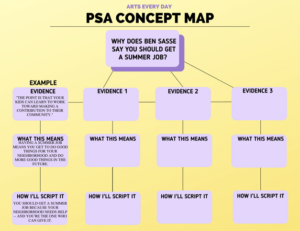
If students need additional supports with reading and writing, consider incorporating a concept map to map out the merits of getting a summer job, incorporating both textual evidence from Ben Sasse’s piece and prior knowledge. Teachers may provide extra supports of sentence starters and quote catchers. Make a concept map available to all students to assist with scripting.
Here is a sample:
VOICE OVER
Students will then do a minute-long voiceover of their argument for why you should get a summer job. Students without technology access will practice and revise scripts prior to performance, with teacher and peer assistance.
-
- Students with technology will use their voiceover to use either the TikTok or Instagram Reels app, incorporating images, visuals, and other mixed media to supplement their voiceover. Teacher will show a tutorial on how to make a TikTok video, and students will collaborate on technical aspects.
- Students can watch this video for additional support on how to make a TikTok video
- After making the video, students will send the video to the teacher through e-mail and students will deliver their arts-integrated public service announcement.
BRAIN TARGETED TEACHING IN THE CLASSROOM
The Learning Environment:
ROOT BRANCH MEDIA GROUP – BRING ROOT BRANCH TO YOUR SCHOOL!
All video content made in partnership with Baltimore’s Root Branch Media Group.
EPHRAIM NEHEMIAH
Ephraim Nehemiah’s poetry uses rhythmic call and response, evocative narratives and accessible subject matter to create a transformative experience for listeners across the nation. The work embraces vulnerability to share personal experiences that create necessary dialogue around race, class and gender. Ephraim is currently a teaching artist for Dewmore Baltimore. A finalist performer in several regional and national competitions such as 2018 Individual World Poetry Slam and 2019 Rustbelt Poetry Slam and in 2021 took the National Slam title with Baltimore’s poetry team Slammageddon. Ephraim has also performed in collaboration with the Museum of Contemporary Art Detroit, The Cleveland Foundation, TEDx Talks, Button Poetry, The Saul William’s World tour and others.
RYAN FAN
Ryan Fan has been teaching special education English in Baltimore City Public Schools the past three years. He spent a year teaching at NACA II Freedom and Democracy Academy before it closed, and then two years at the REACH! Partnership School. He will be continuing in education as an IEP Team Associate to pursue a further career in special education law.
Ryan has an M.S. Ed from Johns Hopkins University, as well as a B.S./B.A. in Neuroscience and English and Creative Writing from Emory University. In his free time, he enjoys running marathons and writing. He runs a blog on the side on Medium and has been published in publications like Business Insider, Psychology Today, and EdSurge, as well as prestigious house Medium publications.
Graph Literacy
Pairs with Springboard Lessons 3.7-3.9
Students will use arts-integrated strategies to analyze graphs, learn the limitations of graph data and how to identify misleading graphs, and interpret different types of textual evidence.
Standards
Getting Ready
Downloads
TEACH!
Brain Connections
Creators
COMMON CORE STATE STANDARDS
- CCSS.ELA-Literacy.W.9-10.1 – Write arguments to support claims in an analysis of substantive topics or texts, using valid reasoning and relevant and sufficient evidence.
- CCSS.ELA-Literacy.RI.9-10.1 – Cite strong and thorough textual evidence to support analysis of what the text says explicitly as well as inferences drawn from the text.
- CCSS.ELA-Literacy.RI.9-10.7 – Analyze various accounts of a subject told in different mediums (e.g., a person’s life story in both print and multimedia), determining which details are emphasized in each account.
- CCSS.ELA-Literacy.RI.9-10.8 – Delineate and evaluate the argument and specific claims in a text, assessing whether the reasoning is valid and the evidence is relevant and sufficient; identify false statements and fallacious reasoning.
NATIONAL ARTS STANDARDS
- Anchor Standard 7: Perceive and anlyze artistic work.
- Anchor Standard 8: Intrepret inetnt and meaning in artistic work.
LEARNING OBJECTIVES
- Students will analyze graphs, looking closely at the limitations of graph data and how to idenifty misleading graphs, connecting their learning to textual evidence.
BIG PICTURE OVERVIEW
ACTIVITIES ROADMAP
HOW TO FACILITATE
Watch the video below to facilitate this activity:
BRAIN TARGETED TEACHING IN THE CLASSROOM
The Learning Environment:
ROOT BRANCH MEDIA GROUP – BRING ROOT BRANCH TO YOUR SCHOOL!
All video content made in partnership with Baltimore’s Root Branch Media Group.
EPHRAIM NEHEMIAH
Ephraim Nehemiah’s poetry uses rhythmic call and response, evocative narratives and accessible subject matter to create a transformative experience for listeners across the nation. The work embraces vulnerability to share personal experiences that create necessary dialogue around race, class and gender. Ephraim is currently a teaching artist for Dewmore Baltimore. A finalist performer in several regional and national competitions such as 2018 Individual World Poetry Slam and 2019 Rustbelt Poetry Slam and in 2021 took the National Slam title with Baltimore’s poetry team Slammageddon. Ephraim has also performed in collaboration with the Museum of Contemporary Art Detroit, The Cleveland Foundation, TEDx Talks, Button Poetry, The Saul William’s World tour and others.
RYAN FAN
Ryan Fan has been teaching special education English in Baltimore City Public Schools the past three years. He spent a year teaching at NACA II Freedom and Democracy Academy before it closed, and then two years at the REACH! Partnership School. He will be continuing in education as an IEP Team Associate to pursue a further career in special education law.
Ryan has an M.S. Ed from Johns Hopkins University, as well as a B.S./B.A. in Neuroscience and English and Creative Writing from Emory University. In his free time, he enjoys running marathons and writing. He runs a blog on the side on Medium and has been published in publications like Business Insider, Psychology Today, and EdSurge, as well as prestigious house Medium publications.
Rant and Ekphrastic Poetry
Pairs with Springboard Module 3
Students use poetry as a means to develop persuasive arguments and compelling evidence. It also gives students the opportunity to perform poetry out loud to their class.
Standards
Getting Ready
Downloads
TEACH!
Brain Connections
Creators
COMMON CORE STATE STANDARDS
- CCSS.ELA-Literacy.W.9-10.1 – Write arguments to support claims in an analysis of substantive topics or texts, using valid reasoning and relevant and sufficient evidence.
- CCSS.ELA-Literacy.W.9-10.4 – Produce clear and coherent writing in which the development, organization, and style are appropriate to task, purpose, and audience.
- CCSS.ELA-Literacy.SL.9-10.4 – Present information, findings, and supporting evidence clearly, concisely, and logically such that listeners can follow the line of reasoning and the organization, development, substance, and style are appropriate to purpose, audience, and task.
NATIONAL ARTS STANDARDS
- Anchor Standard 5: Develop and refine artistic work for presentation.
- Anchor Standard 6: Convey meaning through the presentation of artistic work.
LEARNING OBJECTIVES
- Students will write and perform rant and ekphrastic poems as a means to develop persuasive arguments and compelling evidence, while also employing literary devices.
TEACHER BACKGROUND
- Rant Poems: Poetry written about a frustrating subject with an aim of persuading others of its exasperating nature
- There are no strict rules around poem construction
- Like a stream of consciousness
- Ekphrastic Poems: Poetry written in response to a particular piece of art – literary art inspired by visual art
- Students can write vividly about what they see in the piece of art and/or how the art makes them feel
BIG PICTURE OVERVIEW
ACTIVITIES ROADMAP
STEP ONE: RANT POEMS
Watch the videos below to facilitate rant poems with your students. This video performance by Justin Lamb “For the People Who Ask Me If I’m Tired,” is also a helpful example:
STEP TWO: EKPHRASTIC POEMS
Watch the video below to facilitate ekphrasic poems with your students along with various poem resources for both styles of poetry. View and respond to Kehinde Wiley’s Rumors of War and see an example response, Ode Kehinde Wiley’s Rumors of War, HERE.
BRAIN TARGETED TEACHING IN THE CLASSROOM
The Learning Environment:
ROOT BRANCH MEDIA GROUP – BRING ROOT BRANCH TO YOUR SCHOOL!
All video content made in partnership with Baltimore’s Root Branch Media Group.
EPHRAIM NEHEMIAH
Ephraim Nehemiah’s poetry uses rhythmic call and response, evocative narratives and accessible subject matter to create a transformative experience for listeners across the nation. The work embraces vulnerability to share personal experiences that create necessary dialogue around race, class and gender. Ephraim is currently a teaching artist for Dewmore Baltimore. A finalist performer in several regional and national competitions such as 2018 Individual World Poetry Slam and 2019 Rustbelt Poetry Slam and in 2021 took the National Slam title with Baltimore’s poetry team Slammageddon. Ephraim has also performed in collaboration with the Museum of Contemporary Art Detroit, The Cleveland Foundation, TEDx Talks, Button Poetry, The Saul William’s World tour and others.
RYAN FAN
Ryan Fan has been teaching special education English in Baltimore City Public Schools the past three years. He spent a year teaching at NACA II Freedom and Democracy Academy before it closed, and then two years at the REACH! Partnership School. He will be continuing in education as an IEP Team Associate to pursue a further career in special education law.
Ryan has an M.S. Ed from Johns Hopkins University, as well as a B.S./B.A. in Neuroscience and English and Creative Writing from Emory University. In his free time, he enjoys running marathons and writing. He runs a blog on the side on Medium and has been published in publications like Business Insider, Psychology Today, and EdSurge, as well as prestigious house Medium publications.
Argument Performance
Pairs with Springboard EOM Assessment
Students will construct an argument performance. Students will discuss the poetics that exist within arguments and how to use them to make persuasive and compelling arguments. Students will also be encouraged to incorporate other learnings, including graphs, media literacy, and more.
Standards
Getting Ready
Downloads
TEACH!
Brain Connections
Creators
COMMON CORE STATE STANDARDS
- CCSS.ELA-Literacy.W.9-10.1 – Write arguments to support claims in an analysis of substantive topics or texts, using valid reasoning and relevant and sufficient evidence.
- CCSS.ELA-Literacy.W.9-10.4 – Produce clear and coherent writing in which the development, organization, and style are appropriate to task, purpose, and audience.
- CCSS.ELA-Literacy.SL.9-10.4 – Present information, findings, and supporting evidence clearly, concisely, and logically such that listeners can follow the line of reasoning and the organization, development, substance, and style are appropriate to purpose, audience, and task.
NATIONAL ARTS STANDARDS
- Anchor Standard 5: Develop and refine artistic work for presentation.
- Anchor Standard 6: Convey meaning through the presentation of artistic work.
LEARNING OBJECTIVES
- Students will construct and perform an argument performance that contains persuasive and compelling elements.
BIG PICTURE OVERVIEW
ACTIVITIES ROADMAP
HOW TO FACILITATE
Watch the video below to this arts integrated end of module assessment, using the rubic to guide student learning:
BRAIN TARGETED TEACHING IN THE CLASSROOM
The Learning Environment:
ROOT BRANCH MEDIA GROUP – BRING ROOT BRANCH TO YOUR SCHOOL!
All video content made in partnership with Baltimore’s Root Branch Media Group.
EPHRAIM NEHEMIAH
Ephraim Nehemiah’s poetry uses rhythmic call and response, evocative narratives and accessible subject matter to create a transformative experience for listeners across the nation. The work embraces vulnerability to share personal experiences that create necessary dialogue around race, class and gender. Ephraim is currently a teaching artist for Dewmore Baltimore. A finalist performer in several regional and national competitions such as 2018 Individual World Poetry Slam and 2019 Rustbelt Poetry Slam and in 2021 took the National Slam title with Baltimore’s poetry team Slammageddon. Ephraim has also performed in collaboration with the Museum of Contemporary Art Detroit, The Cleveland Foundation, TEDx Talks, Button Poetry, The Saul William’s World tour and others.
RYAN FAN
Ryan Fan has been teaching special education English in Baltimore City Public Schools the past three years. He spent a year teaching at NACA II Freedom and Democracy Academy before it closed, and then two years at the REACH! Partnership School. He will be continuing in education as an IEP Team Associate to pursue a further career in special education law.
Ryan has an M.S. Ed from Johns Hopkins University, as well as a B.S./B.A. in Neuroscience and English and Creative Writing from Emory University. In his free time, he enjoys running marathons and writing. He runs a blog on the side on Medium and has been published in publications like Business Insider, Psychology Today, and EdSurge, as well as prestigious house Medium publications.
