
Home ➞ Digital Resource Library ➞ ELA ➞
Extreme Settings
Arts Integrated Lesson Plans and Materials for Teaching Hatchet & Wit & Wisom Grade 4 “Extreme Settings”
Scene Sequence

Arts Integrated Routine
In this activity, students will build empathy as a reader and an actor. When explaining what the text says, students will point to specific details and examples from the text, then physically embody the sequence of actions.
Standards
Getting Ready
Downloads
TEACH!
Brain Connections
Creators
COMMON CORE STATE STANDARDS
- CCSS.ELA-Literacy.RL.4.1 – Refer to details and examples in a text when explaining what the text says explicitly and when drawing inferences from the text.
NATIONAL ARTS STANDARDS
- TH:Cr1.1.4.a – Articulate the visual details of imagined worlds, and improvised stories that support the given circumstances in a drama/theatre work.
- TH:Cr1.1.4.c. Imagine how a character might move to support the story and given circumstances in a drama/theatre work.
PURPOSE
-
To refer to details and examples in a text when explaining what the text says explicitly and to describe the overall structure (e.g., chronology, comparison, cause/effect, problem/solution) of events, ideas, concepts, or information in a text or part of a text.
- This activity encourages memory retention and will also help students contextualize their understanding of each text. Embodying the main action points of a particular chapter or section of a text will help the students to make personal connections to the text and have a deeper understanding of some of the internal conflicts that the characters are facing. By physically embodying the sequence of actions, students also are given another pathway to help retain and reinforce the information they have been given.
SUGGESTED IMPLEMENTATION
-
Use this check for understanding throughout the module as an integrated method for reviewing the contents of a given section of text and ensuring students understand the plot and character development.
TECHNIQUE TYPE
- Storyboarding
- Tableau
EVALUATING LEARNING
CONCEPT MAP


TO USE
1. In teams or small groups, students will sketch the main plot points of a given section of a text in a storyboard format.
2. Next students can either take turns acting out what happened first, then, next, last in the text one group at a time, or students can develop a simple tableau for each section of the storyboard and present the sequence to the class.
BRAIN TARGETED TEACHING IN THE CLASSROOM
Emotional Climate:
Physical Environment:
Sensory Stations:
Learn More:
Learn more about Brain Targeted Teaching via Dr. Mariale Hardiman’s site and explore the arts integrated overlay below:
ROOT BRANCH MEDIA GROUP – BRING ROOT BRANCH TO YOUR SCHOOL!
All video content made in partnership with Baltimore’s Root Branch Media Group.
CORI DIOQUINO
Cori Dioquino is a Filipino American actor based in NYC and Baltimore. Her credits include Marvel/Netflix’s Daredevil, CBS’s FBI and New Amsterdam on NBC. She began training as a competitive pianist before switching her focus to theatre while in college. Cori earned her Associate’s degree in Music Performance from Howard Community College and her Bachelor’s in Theatre Studies from Towson University.
Cori is a passionate and outspoken advocate for stronger Filipinx and Asian Pacific Indigenous (API) representation in American arts and entertainment. In 2018, she co-founded the Asian Pasifika Arts Collective (APAC). The arts organization’s mission is to use “art of all platforms to ensure that the stories of Asian Americans and Pacific Indigenous Americans are seen, heard and valued”. In 2020, Cori helped launch the national campaign Unapologetically Asian. The campaign, which was a collaboration between APAC and the creative team of Racism Is A Virus, was created as a response to the growing discrimination towards Asians as a result of the coronavirus pandemic. It aims to empower Asian and Asian American communities to change the conversation about belonging in America.
When Cori isn’t acting or producing, she can be found in the classroom as an arts integration educator, using the arts to engage students as they learn core curriculum and empowering them to excel in the classroom and throughout their daily lives.
Cori is a proud member of SAG-AFTRA and an Equity Member Candidate.
RACHAEL BARILLARI
Rachael Barillari is the manager of the Baltimore Arts Integration Project and the founder of Soul Stori LLC, which produces integrative curricula and resources that seamlessly incorporate SEL and the arts into educational settings. She has served as an Adjunct Professor at Johns Hopkins’ School of Education and has authored several publications, including “The Compassion Formula: Where Head Meets Heart For Greater Well-Being.” Her work emphasizes compassionate and holistic learning environments that nurture every child’s creative core. Rachael holds a Masters in Teaching from JHU and a Masters in Educational Psychology from Columbia University. She is a certified Integrative Wellness Coach and HeartMath Trainer, as well as a former Baltimore City Schools teacher.
Sense Embodiment
Arts Integrated Routine for Sensory Details
In this activity, students engage with the text Hatchet through the lens of the five senses, first finding examples of sensory details in the text, then visualizing the described environment through the five senses.
Standards
Getting Ready
Downloads
TEACH!
Brain Connections
Creators
COMMON CORE STATE STANDARDS
- CCSS.ELA-Literacy.RL.4.1 – Refer to details and examples in a text when explaining what the text says explicitly and when drawing inferences from the text.
NATIONAL ARTS STANDARDS
- TH:Cr1.1.4.a – Articulate the visual details of imagined worlds, and improvised stories that support the given circumstances in a drama/theatre work.
- TH:Cr1.1.4.c. Imagine how a character might move to support the story and given circumstances in a drama/theatre work.
PURPOSE
-
To help students more deeply understand how sensory details “show” the reader what is happening in a story rather than merely “tell.” This supports one of the module’s core learning targets: identifying, analyzing, and applying sensory details.
SUGGESTED IMPLEMENTATION
-
This activity can be used in any of the module lessons that include sensory detail learning targets and standards.
- Connect to Sensory Stations: We suggest implementing these activities throughout the weeks during which you focus on individual senses. As students explore sensory stations each day, begin introducing theater integrated activities that will help them physically connect their sensory experiences to the text. The use of theater combined with sensory stations and activities will also encourage students to build empathy by allowing them to physically imagine with their whole bodies how the character Brian could have felt throughout his journey in Hatchet.
TECHNIQUE TYPE
- Visualization
- Improvisation
EVALUATING LEARNING
CONCEPT MAP

INTRO
1. Students use the Sense Finder graphic organizer to identify examples of sensory details in a given module text.
2. Via group discussion, students share their findings with the class. The teacher may choose to collect findings in a collective visual anchor chart.
3. Teacher prompts students to “embody the sense” through visualization. We suggest that you conduct this activity with your students seated at first. Participating in sensory activities seated and with their eyes closed will allow your students to reflect more on their own experiences rather than focus on their peers’ choices.
VISUALIZATION
After inviting students to close their eyes, prompting can include:
-
- Sight: With your minds’ eyes, imagine that you are in the forest. Look around you and observe your surroundings. From where you are standing or sitting, what do you see all around you?
- Smell: Now that you see your environment, use your imagination to smell the world around you. How do the trees smell? Does the lake have a scent? Can you smell the fresh air? Does it smell pleasant? Or gross?
- Taste: As you become more aware of what’s around you, begin connecting your sense of smell to your sense of taste. Is there anything you smell that makes you feel hungry? Is there a scent that you want to hunt and find? What is that smell? How is your character feeling at this moment?
- Touch: You begin walking toward the scent. You walk slowly through the woods. How does the nature feel as it touches your skin? Are the leaves soft? What about the earth underneath your feet? Are you hot and sweaty? Or are you cold? As you continue to build your awareness of the world around you, also become aware of how your body is starting to feel in this environment.
- Hear: As you walk through the forest what do you hear? How do your footsteps sound? Quiet? Are there leaves that crunch beneath your feet? Are there any animals or bugs you hear? How do you react to these sounds? Are you nervous? Scared? Excited?
EXTENSION
After doing the improvised sensory exploration seated, you can begin to add movement to the activity.
-
- We suggest that the extension happen on a different day to avoid overstimulation and to allow your students to take time and reflect on their experiences for each activity.
- Begin with students in an open space, such as a classroom staging area. Invite them to close their eyes and center their minds before beginning.
- Give clear instructions before you invite students to open their eyes.
- For example, “When you open your eyes, just look at the world around you and observe it.”
- Then, you can invite them to begin moving slowly and with intention as the exercise progresses. You can use the same or similar prompts above regarding the five senses.
BRAIN TARGETED TEACHING IN THE CLASSROOM
Emotional Climate:
Physical Environment:
Sensory Stations:
Learn More:
Learn more about Brain Targeted Teaching via Dr. Mariale Hardiman’s site and explore the arts integrated overlay below:
ROOT BRANCH MEDIA GROUP – BRING ROOT BRANCH TO YOUR SCHOOL!
All video content made in partnership with Baltimore’s Root Branch Media Group.
CORI DIOQUINO
Cori Dioquino is a Filipino American actor based in NYC and Baltimore. Her credits include Marvel/Netflix’s Daredevil, CBS’s FBI and New Amsterdam on NBC. She began training as a competitive pianist before switching her focus to theatre while in college. Cori earned her Associate’s degree in Music Performance from Howard Community College and her Bachelor’s in Theatre Studies from Towson University.
Cori is a passionate and outspoken advocate for stronger Filipinx and Asian Pacific Indigenous (API) representation in American arts and entertainment. In 2018, she co-founded the Asian Pasifika Arts Collective (APAC). The arts organization’s mission is to use “art of all platforms to ensure that the stories of Asian Americans and Pacific Indigenous Americans are seen, heard and valued”. In 2020, Cori helped launch the national campaign Unapologetically Asian. The campaign, which was a collaboration between APAC and the creative team of Racism Is A Virus, was created as a response to the growing discrimination towards Asians as a result of the coronavirus pandemic. It aims to empower Asian and Asian American communities to change the conversation about belonging in America.
When Cori isn’t acting or producing, she can be found in the classroom as an arts integration educator, using the arts to engage students as they learn core curriculum and empowering them to excel in the classroom and throughout their daily lives.
Cori is a proud member of SAG-AFTRA and an Equity Member Candidate.
RACHAEL BARILLARI
Rachael Barillari is the manager of the Baltimore Arts Integration Project and the founder of Soul Stori LLC, which produces integrative curricula and resources that seamlessly incorporate SEL and the arts into educational settings. She has served as an Adjunct Professor at Johns Hopkins’ School of Education and has authored several publications, including “The Compassion Formula: Where Head Meets Heart For Greater Well-Being.” Her work emphasizes compassionate and holistic learning environments that nurture every child’s creative core. Rachael holds a Masters in Teaching from JHU and a Masters in Educational Psychology from Columbia University. She is a certified Integrative Wellness Coach and HeartMath Trainer, as well as a former Baltimore City Schools teacher.
Power of Punctuation
Arts Integrated Routine for Punctuation
Students will practice punctuation through embodiment and voice acting, applying these skills to deepen their analysis of excerpts from Hatchet.
Standards
Getting Ready
Downloads
TEACH!
Brain Connections
Creators
COMMON CORE STATE STANDARDS
- CCSS.ELA-Literacy.L.4.2 – Demonstrate command of the conventions of standard English capitalization, punctuation, and spelling when writing.
NATIONAL ARTS STANDARDS
- TH:Cr3.1.4.b – Develop physical and vocal exercise techniques for an improvised or scripted drama/theatre work.
PURPOSE
-
To help students explore how punctuation impacts the pacing, tone, and development of a text, as well as how punctuation is a tool writers use to express characterization. Students will then be able to better apply this skill when developing the characters in their own narratives. Additionally, these activities benefit reading fluency, as it supports students in connecting to the mechanics and conventions of a grade level text.
SUGGESTED IMPLEMENTATION
-
These activities can be used throughout the module in any lesson that highlights attention to punctuation as a focus standard.
TECHNIQUE TYPE
- Improvisation
- Voice Acting
EVALUATING LEARNING
CONCEPT MAP
OPTION A
Embodiment:
1. On a digital board in your classroom, project the “Punctuation Embodiment” chart below. Select a passage from the text to focus on.
2. Explain the directions to students: As you read the passage aloud, when students see punctuation, they embody one of the following movements accordingly. Note: This can be a seated activity with the hand gestures option, or, this can be a more movement-based activity with the full body option.
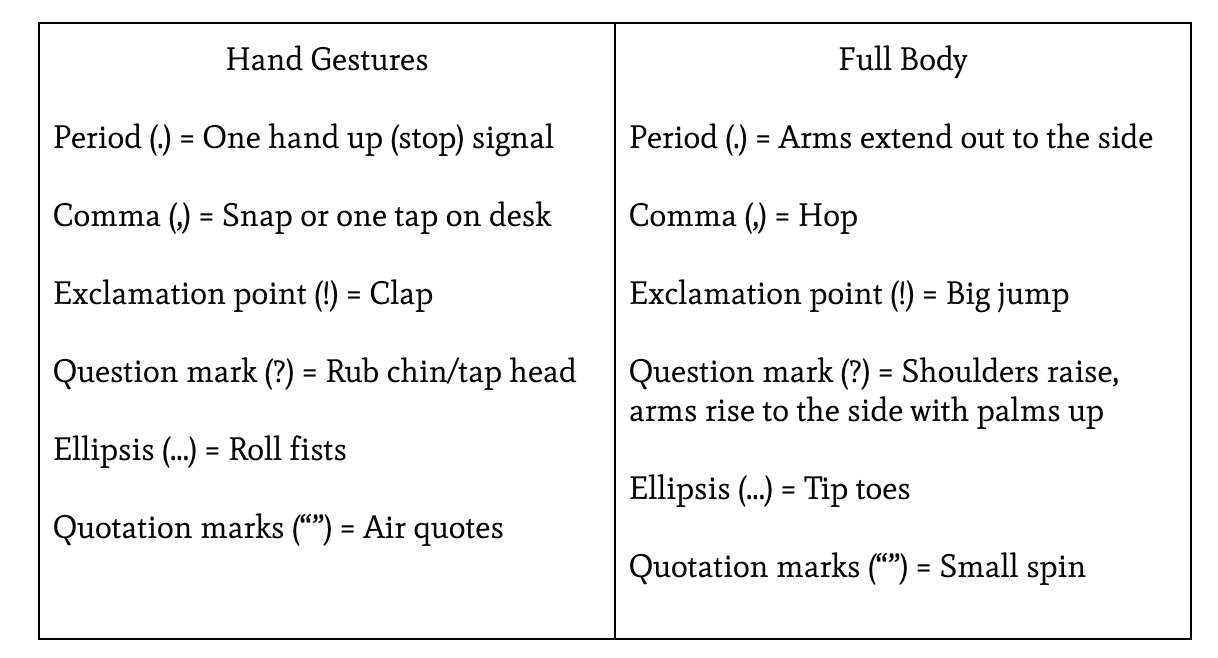
3. Read the passage aloud as students embody the punctuation marks.
Extension: Have students read the passage, highlighting their fluency strengths.
OPTION B
Voice:
1. On a digital board in your classroom, project three excerpts from the text aligned to the module lesson featuring character dialogue. The first version of the text should use the punctuation as it is presented in the text. The second and third should change the punctuation.
2. Have students read the three versions, applying the module fluency goal of “expression” as they read. Point out how different the dialogue sounds when the punctuation changes.
3. Ask students to explain how punctuation helps us to understand traits of a given character. Remind students to keep this in mind as they craft the characters in their own narratives.
BRAIN TARGETED TEACHING IN THE CLASSROOM
Emotional Climate:
Physical Environment:
Sensory Stations:
Learn More:
Learn more about Brain Targeted Teaching via Dr. Mariale Hardiman’s site and explore the arts integrated overlay below:
ROOT BRANCH MEDIA GROUP – BRING ROOT BRANCH TO YOUR SCHOOL!
All video content made in partnership with Baltimore’s Root Branch Media Group.
CORI DIOQUINO
Cori Dioquino is a Filipino American actor based in NYC and Baltimore. Her credits include Marvel/Netflix’s Daredevil, CBS’s FBI and New Amsterdam on NBC. She began training as a competitive pianist before switching her focus to theatre while in college. Cori earned her Associate’s degree in Music Performance from Howard Community College and her Bachelor’s in Theatre Studies from Towson University.
Cori is a passionate and outspoken advocate for stronger Filipinx and Asian Pacific Indigenous (API) representation in American arts and entertainment. In 2018, she co-founded the Asian Pasifika Arts Collective (APAC). The arts organization’s mission is to use “art of all platforms to ensure that the stories of Asian Americans and Pacific Indigenous Americans are seen, heard and valued”. In 2020, Cori helped launch the national campaign Unapologetically Asian. The campaign, which was a collaboration between APAC and the creative team of Racism Is A Virus, was created as a response to the growing discrimination towards Asians as a result of the coronavirus pandemic. It aims to empower Asian and Asian American communities to change the conversation about belonging in America.
When Cori isn’t acting or producing, she can be found in the classroom as an arts integration educator, using the arts to engage students as they learn core curriculum and empowering them to excel in the classroom and throughout their daily lives.
Cori is a proud member of SAG-AFTRA and an Equity Member Candidate.
RACHAEL BARILLARI
Rachael Barillari is the manager of the Baltimore Arts Integration Project and the founder of Soul Stori LLC, which produces integrative curricula and resources that seamlessly incorporate SEL and the arts into educational settings. She has served as an Adjunct Professor at Johns Hopkins’ School of Education and has authored several publications, including “The Compassion Formula: Where Head Meets Heart For Greater Well-Being.” Her work emphasizes compassionate and holistic learning environments that nurture every child’s creative core. Rachael holds a Masters in Teaching from JHU and a Masters in Educational Psychology from Columbia University. She is a certified Integrative Wellness Coach and HeartMath Trainer, as well as a former Baltimore City Schools teacher.
Ready, Setting, Go!
Arts Integrated Routine for Setting
Through charades, students will analyze the setting throughout Hatchet, gathering text evidence to support what they see. Students will discuss and portray setting connections to feelings and emotions.
Standards
Getting Ready
Downloads
TEACH!
Brain Connections
Creators
COMMON CORE STATE STANDARDS
- CCSS.ELA-Literacy.RL.4.1 – Refer to details and examples in a text when explaining what the text says explicitly and when drawing inferences from the text.
- CCSS.ELA-Literacy.RL.4.3 – Describe in depth a character, setting, or event in a story or drama, drawing on specific details in the text (e.g., a character’s thoughts, words, or actions).
NATIONAL ARTS STANDARDS
- TH:Cr1.1.4.a – Articulate the visual details of imagined worlds, and improvised stories that support the given circumstances in a drama/theatre work.
- TH:Cr1.1.4.c. Imagine how a character might move to support the story and given circumstances in a drama/theatre work.
PURPOSE
- To help students better understand the influential role of setting in a text. Wit & Wisdom expresses that in these module texts, the setting acts almost as a character itself. When students write their own narratives, they will be better able to engage with the setting and make it a vital part of their own story.
SUGGESTED IMPLEMENTATION
- The game version of this activity can be used as a content aligned warm up or brain break whenever needed.
- The setting as a character analysis prompt can be used in any lesson where setting is analyzed and is highly recommended during the planning process of the students’ End of Module Task.
TECHNIQUE TYPE
- Charades
- Visualization
EVALUATING LEARNING
CONCEPT MAP
OPTION A
Ready, Setting, Go! Setting Charades Brain Break:
1. Using index cards, have students create two sets of charades cards, A and B. For Set A, have students brainstorm as many different settings as they can think of. Sometimes, the sillier the better. For Set B, have students write various verbs, one per card.
2. Divide the class into teams or call students to the buckets one at a time.
3. The student player selects one card from each set. Then, silently act out the verb in the context of the setting. For example, a student who selects “scorching hot desert with sand storm winds” from Set A, and “walking” from Set B, may act this out by walking slowly, pretending to struggle to move in the intense heat.
4. Set a timer for 1 minute. As the student acts, the rest of the class or the students’ team must guess the setting.
OPTION B
Setting as Character Analysis Prompts:
1. When analyzing the setting of a given text, ask students:
-
- How is the setting contributing to what is happening right now in the text? What text evidence of this do you see?
- If the setting had an emotion right now, how would you describe what it is feeling? What kind of facial expression would it make?
Extension: Students can work in small groups to form a tableau depicting how the setting is feeling in a given scene.
BRAIN TARGETED TEACHING IN THE CLASSROOM
Emotional Climate:
Physical Environment:
Sensory Stations:
Learn More:
Learn more about Brain Targeted Teaching via Dr. Mariale Hardiman’s site and explore the arts integrated overlay below:
ROOT BRANCH MEDIA GROUP – BRING ROOT BRANCH TO YOUR SCHOOL!
All video content made in partnership with Baltimore’s Root Branch Media Group.
CORI DIOQUINO
Cori Dioquino is a Filipino American actor based in NYC and Baltimore. Her credits include Marvel/Netflix’s Daredevil, CBS’s FBI and New Amsterdam on NBC. She began training as a competitive pianist before switching her focus to theatre while in college. Cori earned her Associate’s degree in Music Performance from Howard Community College and her Bachelor’s in Theatre Studies from Towson University.
Cori is a passionate and outspoken advocate for stronger Filipinx and Asian Pacific Indigenous (API) representation in American arts and entertainment. In 2018, she co-founded the Asian Pasifika Arts Collective (APAC). The arts organization’s mission is to use “art of all platforms to ensure that the stories of Asian Americans and Pacific Indigenous Americans are seen, heard and valued”. In 2020, Cori helped launch the national campaign Unapologetically Asian. The campaign, which was a collaboration between APAC and the creative team of Racism Is A Virus, was created as a response to the growing discrimination towards Asians as a result of the coronavirus pandemic. It aims to empower Asian and Asian American communities to change the conversation about belonging in America.
When Cori isn’t acting or producing, she can be found in the classroom as an arts integration educator, using the arts to engage students as they learn core curriculum and empowering them to excel in the classroom and throughout their daily lives.
Cori is a proud member of SAG-AFTRA and an Equity Member Candidate.
RACHAEL BARILLARI
Rachael Barillari is the manager of the Baltimore Arts Integration Project and the founder of Soul Stori LLC, which produces integrative curricula and resources that seamlessly incorporate SEL and the arts into educational settings. She has served as an Adjunct Professor at Johns Hopkins’ School of Education and has authored several publications, including “The Compassion Formula: Where Head Meets Heart For Greater Well-Being.” Her work emphasizes compassionate and holistic learning environments that nurture every child’s creative core. Rachael holds a Masters in Teaching from JHU and a Masters in Educational Psychology from Columbia University. She is a certified Integrative Wellness Coach and HeartMath Trainer, as well as a former Baltimore City Schools teacher.
Mistakes Happen Improv
Arts Integrated Routine
Students will better understand Brian’s experience in Hatchet by learning and growing from mistakes through this improv activity, citing sensory details while also summarizing narratives in a supportive class setting.
Standards
Getting Ready
Downloads
TEACH!
Brain Connections
Creators
COMMON CORE STATE STANDARDS
- CCSS.ELA-Literacy.W.4.2.c – Link ideas within categories of information using words and phrases (e.g., another, for example, also, because).
- CCSS.ELA-Literacy.W.4.3 – Write narratives to develop real or imagined experiences or events using effective technique, descriptive details, and clear event sequences.
NATIONAL ARTS STANDARDS
- TH:Cr1.1.4.a – Articulate the visual details of imagined worlds, and improvised stories that support the given circumstances in a drama/theatre work.
- TH:Cr1.1.4.c. Imagine how a character might move to support the story and given circumstances in a drama/theatre work.
PURPOSE
- One of the major themes throughout Hatchet is the idea that mistakes are necessary for Brian to learn and grow. He acknowledges frequently that who he was at the beginning of his survival journey is vastly different from who he has become by the end of the book. It’s important for students to understand that mistakes are a necessary part of life. Using theater and improvisation can help encourage students to feel less fearful of making mistakes and open their minds to the possibilities that those mistakes can offer for growth and evolution.
SUGGESTED IMPLEMENTATION
- Begin by having your class sit in a circle. We encourage you to offer your students a choice of how to sit – whether that’s on the floor, in a chair or on another type of seat such as an active learning stool. Giving students a choice in how they can sit also ensures that they are comfortable while participating in this activity, which will encourage creativity and openness to potential outcomes.
TECHNIQUE TYPE
- Improvisation: In improv and theater, we use a concept called “Yes, and…” The idea is that saying “Yes, and…” to your scene partner during an improvised scene keeps the action moving forward and allows for endless possibilities. However, if you respond to your partner with, “No,” it invalidates any choices and suggestions that they have to offer and immediately ends the scene.
MORE ON IMPROV: YES AND…
- When using improv, artists tie the concept of “Yes, and…” to real-life scenarios. Being open to what others have to offer and say allows for more positive experiences and working relationships. Saying “yes” signals to your partners and peers that you have heard and acknowledged what they’ve said, while responding with “and” communicates that you are adding onto their good ideas rather than negating them.
- This simple “Yes, and…” activity with your students will encourage them to work together as a team, think critically of “The Moment Before” prior to responding, and will empower them to see less than ideal choices as opportunities rather than mistakes.
- Note: “The Moment Before” is another theater term. It refers to the action that happened before a scene takes place. It’s usually a moment that isn’t seen by the audience, but may be referred to by the characters in the play. As actors, we are encouraged to think of “The Moment Before” as we develop characters and analyze scenes. This is another great theater tool for building empathy and understanding with your students.
EVALUATING LEARNING
CONCEPT MAP
INTRO
Brainstorm with your students possible settings they would like for a story to take place. After you’ve created a list, draw one at random to use.
EXPERIENCE
1. Invite students to sit in a circle. Once seated, mark three students to signify the beginning, middle and end of their story. The first student starts the story based on the given setting, the students toward the middle should consider building a climax in the story, while the students at the end must find a way to conclude.
2. Once the story commences, each student should open their sentence with “yes… and…” before adding to the story. Prompt them to repeat what was said before them so that they can remember the plot elements already offered before continuing. This sentence structure could sound like this: “Yes, the bear was walking through the woods, and he felt a cool breeze.”
3. Instruct students to include one sensory detail in their sentence. For example: “Yes, the bear felt a cool breeze, and he smelled a campfire in the distance.”
WRAP UP
4. When the story has concluded, re-recall the plot with your students and write on the board or a piece of chart paper. It’s helpful and encouraging for students to see their final work as well as hear it out loud. Make sure to celebrate the creation of an improvised story together.
BRAIN TARGETED TEACHING IN THE CLASSROOM
Emotional Climate:
Physical Environment:
Sensory Stations:
Learn More:
Learn more about Brain Targeted Teaching via Dr. Mariale Hardiman’s site and explore the arts integrated overlay below:
ROOT BRANCH MEDIA GROUP – BRING ROOT BRANCH TO YOUR SCHOOL!
All video content made in partnership with Baltimore’s Root Branch Media Group.
CORI DIOQUINO
Cori Dioquino is a Filipino American actor based in NYC and Baltimore. Her credits include Marvel/Netflix’s Daredevil, CBS’s FBI and New Amsterdam on NBC. She began training as a competitive pianist before switching her focus to theatre while in college. Cori earned her Associate’s degree in Music Performance from Howard Community College and her Bachelor’s in Theatre Studies from Towson University.
Cori is a passionate and outspoken advocate for stronger Filipinx and Asian Pacific Indigenous (API) representation in American arts and entertainment. In 2018, she co-founded the Asian Pasifika Arts Collective (APAC). The arts organization’s mission is to use “art of all platforms to ensure that the stories of Asian Americans and Pacific Indigenous Americans are seen, heard and valued”. In 2020, Cori helped launch the national campaign Unapologetically Asian. The campaign, which was a collaboration between APAC and the creative team of Racism Is A Virus, was created as a response to the growing discrimination towards Asians as a result of the coronavirus pandemic. It aims to empower Asian and Asian American communities to change the conversation about belonging in America.
When Cori isn’t acting or producing, she can be found in the classroom as an arts integration educator, using the arts to engage students as they learn core curriculum and empowering them to excel in the classroom and throughout their daily lives.
Cori is a proud member of SAG-AFTRA and an Equity Member Candidate.
RACHAEL BARILLARI
Rachael Barillari is the manager of the Baltimore Arts Integration Project and the founder of Soul Stori LLC, which produces integrative curricula and resources that seamlessly incorporate SEL and the arts into educational settings. She has served as an Adjunct Professor at Johns Hopkins’ School of Education and has authored several publications, including “The Compassion Formula: Where Head Meets Heart For Greater Well-Being.” Her work emphasizes compassionate and holistic learning environments that nurture every child’s creative core. Rachael holds a Masters in Teaching from JHU and a Masters in Educational Psychology from Columbia University. She is a certified Integrative Wellness Coach and HeartMath Trainer, as well as a former Baltimore City Schools teacher.
