Home ➞ Digital Resource Library ➞ ELA ➞
I am a Hero
Arts Integrated Lesson Plans and Materials for Teaching Civil Rights & Wit & Wisdom Grade 2 “Civil Rights Hero”
Poem Writing

Pairs with Wit & Wisdom FQT1
Students will use music exploration to guide them through poem writing, expressing themselves in a unique way, preparing them for informative paragraph writing to describe injustices that occured before the Civil Rights Act of 1964.
Standards
Getting Ready
Downloads
TEACH!
Brain Connections
Creators
COMMON CORE STATE STANDARDS
- CCSS.ELA-Literacy.RL.2.3 – Describe how characters in a story respond to major events and challenges.
- CCSS.ELA-Literacy.RL.2.6 – Acknowledge differences in the points of view of characters, including by speaking in a different voice for each character when reading dialogue aloud.
- CCSS.ELA-Literacy.SL.2.3 – Ask and answer questions about what a speaker says in order to clarify comprehension, gather additional information, or deepen understanding of a topic or issue.
NATIONAL ARTS STANDARDS
- MU:Pr4.1.2a – Demonstrate and explain personal interest in, knowledge about, and purpose of varied musical selections.
OVERVIEW
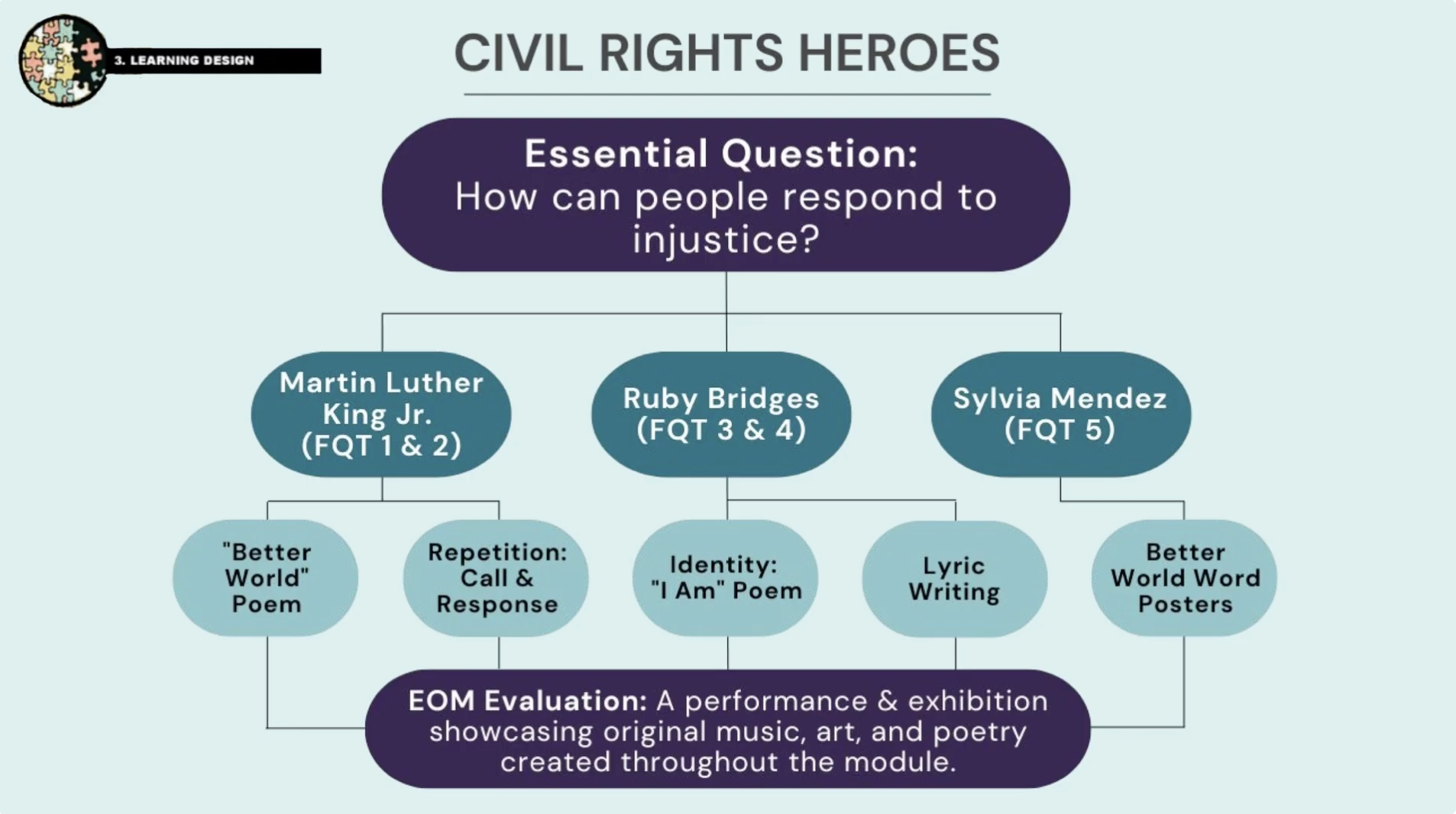
- Students put themselves in the shoes of three civil rights leaders: Martin Luther King Jr., Ruby Bridges, and Sylvia Mendez in order to develop their narrative writing skills
- Students explore various civil approaches to fighting injustice such as songs, speeches, and protests
- Students will have the opportunity to create music, art, and poetry in relation to the focusing question arcs of the module
KEY UNDERSTANDINGS
- Recognize how people respond to injustices
- Identify leaders of the civil rights movement
- Understand the character’s point of view
- Speak on a topic with peers
LESSON OBJECTIVE
- Analyze poetry and lyrics
- Compose narrative poetry
ESSENTIAL QUESTION
- How can people respond to injustice?
ARTS ESSENTIAL QUESTIONS
- How did music play a role in the civil rights movement?
- How can we use music to express what we believe today?
END OF MODULE TASK
- A performance and exhibition showcasing original music, art, and poetry created throughout the module.

STEP ONE
Watch the video to facilitate poem writing through music.
STEP TWO
Look at poems and songs to gather words that go with the theme of “Better World.” Consider using the music and poetry of:
- Langston Hughes, Dreams
- Louis Armstrong, What a Wonderful World
- Israel Kamakawiwo’ole, Somewhere Over the Rainbow
- Ella Fitzgerald, Brighten the Corner Where You Are
DOWNLOAD: Lyric and Poem Examples
STEP THREE
Create a wordcloud with student selected words from the lyrics and poetry. The video below provides a wordcloud demo.
STEP FOUR
Students create their poems using the template linked below.
DOWNLOAD: Poem Writing Template
BRAIN TARGETED TEACHING IN THE CLASSROOM
ROOT BRANCH MEDIA GROUP – BRING ROOT BRANCH TO YOUR SCHOOL!
All video content made in partnership with Baltimore’s Root Branch Media Group.
JORDAN MOORE
Jordan Moore is a euphoniumist, ocarinist, hornist, arranger, educator, and online content creator native to Columbia, Maryland. In 2019, Jordan graduated from the Eastman School of Music with a degree in euphonium performance and music education, and he currently teaches middle school orchestra and guitar at Perry Hall Middle School in Baltimore County. Best known for his one-person wind ensemble arrangement of Lugia’s Song, Jordan also produces YouTube videos of his own arrangements and performances of mostly classical, anime, and video game music. Jordan began playing euphonium at age 10, but quickly became interested in learning other instruments. A couple years later, Jordan began making YouTube videos utilizing many of the instruments he was learning. With his YouTube channel, Jordan currently strives to show that underrated instruments such as ocarina and euphonium can play beautiful and serious music.
LEAH JORGENSEN-MOORE
Leah Jorgensen-Moore is a new Baltimore resident who currently teaches Special Education at John Ruhah Elementary School. She has a Bachelor’s in Music Education from the Eastman School of Music. She enjoys integrating music into her classroom daily and finds that her students learn best when using the arts. Leah started a music program during her time at College in inner City Rochester, and now enjoys working with Baltimore Symphony’s Orch kids when she can. Leah is still an active musician creating videos with her spouse Jordan, playing in Orchestra in the community, and teaching private lessons. In Leah’s spare time she enjoys cooking, lifting weights, spending time outdoors, hosting friends over at her house, going to church, and serving the community.
Call and Response
Pairs with Wit & Wisdom FQT2
Students explore This Little Light of Mine and recognize the impact that it had on the time and learn how music and help lead change. Students will compose a verse to a call and response song “I have a Dream.” Students will express their dream for the world and reflect on the ways they can cause positive change.
Standards
Getting Ready
Downloads
TEACH!
Brain Connections
Creators
COMMON CORE STATE STANDARDS
- CCSS.ELA-Literacy.RL.2.3 – Describe how characters in a story respond to major events and challenges.
- CCSS.ELA-Literacy.RL.2.6 – Acknowledge differences in the points of view of characters, including by speaking in a different voice for each character when reading dialogue aloud.
- CCSS.ELA-Literacy.SL.2.3 – Ask and answer questions about what a speaker says in order to clarify comprehension, gather additional information, or deepen understanding of a topic or issue.
NATIONAL ARTS STANDARDS
- MU:Pr4.1.2a – Demonstrate and explain personal interest in, knowledge about, and purpose of varied musical selections.
OVERVIEW
- Students put themselves in the shoes of three civil rights leaders: Martin Luther King Jr., Ruby Bridges, and Sylvia Mendez in order to develop their narrative writing skills
- Students explore various civil approaches to fighting injustice such as songs, speeches, and protests
- Students will have the opportunity to create music, art, and poetry in relation to the focusing question arcs of the module
KEY UNDERSTANDINGS
- Recognize how people respond to injustices
- Identify leaders of the civil rights movement
- Understand the character’s point of view
- Speak on a topic with peers
LESSON OBJECTIVE
- Analyze and write lyrics
ESSENTIAL QUESTION
- How can people respond to injustice?
ARTS ESSENTIAL QUESTIONS
- How did music play a role in the civil rights movement?
- How can we use music to express what we believe today?
END OF MODULE TASK
- A performance and exhibition showcasing original music, art, and poetry created throughout the module.
STEP ONE
Watch the video to facilitate call and response songs with repetition
STEP TWO
Teach the “I have a Dream” song using this video guide and the accompanying lyrics or the provided audio and guide students in composing their own verses.
BRAIN TARGETED TEACHING IN THE CLASSROOM
ROOT BRANCH MEDIA GROUP – BRING ROOT BRANCH TO YOUR SCHOOL!
All video content made in partnership with Baltimore’s Root Branch Media Group.
JORDAN MOORE
Jordan Moore is a euphoniumist, ocarinist, hornist, arranger, educator, and online content creator native to Columbia, Maryland. In 2019, Jordan graduated from the Eastman School of Music with a degree in euphonium performance and music education, and he currently teaches middle school orchestra and guitar at Perry Hall Middle School in Baltimore County. Best known for his one-person wind ensemble arrangement of Lugia’s Song, Jordan also produces YouTube videos of his own arrangements and performances of mostly classical, anime, and video game music. Jordan began playing euphonium at age 10, but quickly became interested in learning other instruments. A couple years later, Jordan began making YouTube videos utilizing many of the instruments he was learning. With his YouTube channel, Jordan currently strives to show that underrated instruments such as ocarina and euphonium can play beautiful and serious music.
LEAH JORGENSEN-MOORE
Leah Jorgensen-Moore is a new Baltimore resident who currently teaches Special Education at John Ruhah Elementary School. She has a Bachelor’s in Music Education from the Eastman School of Music. She enjoys integrating music into her classroom daily and finds that her students learn best when using the arts. Leah started a music program during her time at College in inner City Rochester, and now enjoys working with Baltimore Symphony’s Orch kids when she can. Leah is still an active musician creating videos with her spouse Jordan, playing in Orchestra in the community, and teaching private lessons. In Leah’s spare time she enjoys cooking, lifting weights, spending time outdoors, hosting friends over at her house, going to church, and serving the community.
I am Poem 

Pairs with Wit & Wisdom FQT3
Students engage in reflective thinking of what they imagine as their future for themselves and the world by creating an I am poem.
Standards
Getting Ready
Downloads
TEACH!
Brain Connections
Creators
COMMON CORE STATE STANDARDS
- CCSS.ELA-Literacy.RL.2.3 – Describe how characters in a story respond to major events and challenges.
- CCSS.ELA-Literacy.RL.2.6 – Acknowledge differences in the points of view of characters, including by speaking in a different voice for each character when reading dialogue aloud.
- CCSS.ELA-Literacy.SL.2.3 – Ask and answer questions about what a speaker says in order to clarify comprehension, gather additional information, or deepen understanding of a topic or issue.
NATIONAL ARTS STANDARDS
- Anchor Standard 6: Convey meaning through the presentation of artistic work.
OVERVIEW
- Students put themselves in the shoes of three civil rights leaders: Martin Luther King Jr., Ruby Bridges, and Sylvia Mendez in order to develop their narrative writing skills
- Students explore various civil approaches to fighting injustice such as songs, speeches, and protests
- Students will have the opportunity to create music, art, and poetry in relation to the focusing question arcs of the module
KEY UNDERSTANDINGS
- Recognize how people respond to injustices
- Identify leaders of the civil rights movement
- Understand the character’s point of view
- Speak on a topic with peers
LESSON OBJECTIVE
- Compose narrative poetry
ESSENTIAL QUESTION
- How can people respond to injustice?
ARTS ESSENTIAL QUESTIONS
- How did music play a role in the civil rights movement?
- How can we use music to express what we believe today?
END OF MODULE TASK
- A performance and exhibition showcasing original music, art, and poetry created throughout the module.
STEP ONE
Watch the video to facilitate writing an I am Poem and use the accompanying template to support students in the writing process.
BRAIN TARGETED TEACHING IN THE CLASSROOM
ROOT BRANCH MEDIA GROUP – BRING ROOT BRANCH TO YOUR SCHOOL!
All video content made in partnership with Baltimore’s Root Branch Media Group.
JORDAN MOORE
Jordan Moore is a euphoniumist, ocarinist, hornist, arranger, educator, and online content creator native to Columbia, Maryland. In 2019, Jordan graduated from the Eastman School of Music with a degree in euphonium performance and music education, and he currently teaches middle school orchestra and guitar at Perry Hall Middle School in Baltimore County. Best known for his one-person wind ensemble arrangement of Lugia’s Song, Jordan also produces YouTube videos of his own arrangements and performances of mostly classical, anime, and video game music. Jordan began playing euphonium at age 10, but quickly became interested in learning other instruments. A couple years later, Jordan began making YouTube videos utilizing many of the instruments he was learning. With his YouTube channel, Jordan currently strives to show that underrated instruments such as ocarina and euphonium can play beautiful and serious music.
LEAH JORGENSEN-MOORE
Leah Jorgensen-Moore is a new Baltimore resident who currently teaches Special Education at John Ruhah Elementary School. She has a Bachelor’s in Music Education from the Eastman School of Music. She enjoys integrating music into her classroom daily and finds that her students learn best when using the arts. Leah started a music program during her time at College in inner City Rochester, and now enjoys working with Baltimore Symphony’s Orch kids when she can. Leah is still an active musician creating videos with her spouse Jordan, playing in Orchestra in the community, and teaching private lessons. In Leah’s spare time she enjoys cooking, lifting weights, spending time outdoors, hosting friends over at her house, going to church, and serving the community.
Ruby’s Point of View
Pairs with Wit & Wisdom FQT4
Students engage in first person narrative writing from the point of view of Civil Rights Hero Ruby Bridges by creating a verse to a song about her experience as a student at William Frantz Elementary School.
Standards
Getting Ready
Downloads
TEACH!
Brain Connections
Creators
COMMON CORE STATE STANDARDS
- CCSS.ELA-Literacy.RL.2.3 – Describe how characters in a story respond to major events and challenges.
- CCSS.ELA-Literacy.RL.2.6 – Acknowledge differences in the points of view of characters, including by speaking in a different voice for each character when reading dialogue aloud.
- CCSS.ELA-Literacy.SL.2.3 – Ask and answer questions about what a speaker says in order to clarify comprehension, gather additional information, or deepen understanding of a topic or issue.
NATIONAL ARTS STANDARDS
- MU:Pr4.1.2a – Demonstrate and explain personal interest in, knowledge about, and purpose of varied musical selections.
- Anchor Standard 6: Convey meaning through the presentation of artistic work.
OVERVIEW
- Students put themselves in the shoes of three civil rights leaders: Martin Luther King Jr., Ruby Bridges, and Sylvia Mendez in order to develop their narrative writing skills
- Students explore various civil approaches to fighting injustice such as songs, speeches, and protests
- Students will have the opportunity to create music, art, and poetry in relation to the focusing question arcs of the module
KEY UNDERSTANDINGS
- Recognize how people respond to injustices
- Identify leaders of the civil rights movement
- Understand the character’s point of view
- Speak on a topic with peers
LESSON OBJECTIVE
- Analyze and write lyrics
ESSENTIAL QUESTION
- How can people respond to injustice?
ARTS ESSENTIAL QUESTIONS
- How did music play a role in the civil rights movement?
- How can we use music to express what we believe today?
END OF MODULE TASK
- A performance and exhibition showcasing original music, art, and poetry created throughout the module.
STEP ONE
Watch the video to facilitate writing lyrics from Ruby’s point of view and use the accompanying lyrics and audio to support students in the writing process.
BRAIN TARGETED TEACHING IN THE CLASSROOM
ROOT BRANCH MEDIA GROUP – BRING ROOT BRANCH TO YOUR SCHOOL!
All video content made in partnership with Baltimore’s Root Branch Media Group.
JORDAN MOORE
Jordan Moore is a euphoniumist, ocarinist, hornist, arranger, educator, and online content creator native to Columbia, Maryland. In 2019, Jordan graduated from the Eastman School of Music with a degree in euphonium performance and music education, and he currently teaches middle school orchestra and guitar at Perry Hall Middle School in Baltimore County. Best known for his one-person wind ensemble arrangement of Lugia’s Song, Jordan also produces YouTube videos of his own arrangements and performances of mostly classical, anime, and video game music. Jordan began playing euphonium at age 10, but quickly became interested in learning other instruments. A couple years later, Jordan began making YouTube videos utilizing many of the instruments he was learning. With his YouTube channel, Jordan currently strives to show that underrated instruments such as ocarina and euphonium can play beautiful and serious music.
LEAH JORGENSEN-MOORE
Leah Jorgensen-Moore is a new Baltimore resident who currently teaches Special Education at John Ruhah Elementary School. She has a Bachelor’s in Music Education from the Eastman School of Music. She enjoys integrating music into her classroom daily and finds that her students learn best when using the arts. Leah started a music program during her time at College in inner City Rochester, and now enjoys working with Baltimore Symphony’s Orch kids when she can. Leah is still an active musician creating videos with her spouse Jordan, playing in Orchestra in the community, and teaching private lessons. In Leah’s spare time she enjoys cooking, lifting weights, spending time outdoors, hosting friends over at her house, going to church, and serving the community.
Poster Creation

Pairs with Wit & Wisdom FQT5
Students engage in first person narrative writing from the point of view of Sylvia Mendez by creating a poster that reflects the poem written during during FQT1 as part of their vision for a better world.
Standards
Getting Ready
Downloads
TEACH!
Brain Connections
Creators
COMMON CORE STATE STANDARDS
- CCSS.ELA-Literacy.RL.2.3 – Describe how characters in a story respond to major events and challenges.
- CCSS.ELA-Literacy.RL.2.6 – Acknowledge differences in the points of view of characters, including by speaking in a different voice for each character when reading dialogue aloud.
- CCSS.ELA-Literacy.SL.2.3 – Ask and answer questions about what a speaker says in order to clarify comprehension, gather additional information, or deepen understanding of a topic or issue.
NATIONAL ARTS STANDARDS
- VA:Cn10.1.2a – Create works of art about events in home, school, or community life.
OVERVIEW
- Students put themselves in the shoes of three civil rights leaders: Martin Luther King Jr., Ruby Bridges, and Sylvia Mendez in order to develop their narrative writing skills
- Students explore various civil approaches to fighting injustice such as songs, speeches, and protests
- Students will have the opportunity to create music, art, and poetry in relation to the focusing question arcs of the module
KEY UNDERSTANDINGS
- Recognize how people respond to injustices
- Identify leaders of the civil rights movement
- Understand the character’s point of view
- Speak on a topic with peers
LESSON OBJECTIVE
- Design self-portraits and posters
ESSENTIAL QUESTION
- How can people respond to injustice?
ARTS ESSENTIAL QUESTIONS
- How did music play a role in the civil rights movement?
- How can we use music to express what we believe today?
END OF MODULE TASK
- A performance and exhibition showcasing original music, art, and poetry created throughout the module.
BRAIN TARGETED TEACHING IN THE CLASSROOM
ROOT BRANCH MEDIA GROUP – BRING ROOT BRANCH TO YOUR SCHOOL!
All video content made in partnership with Baltimore’s Root Branch Media Group.
JORDAN MOORE
Jordan Moore is a euphoniumist, ocarinist, hornist, arranger, educator, and online content creator native to Columbia, Maryland. In 2019, Jordan graduated from the Eastman School of Music with a degree in euphonium performance and music education, and he currently teaches middle school orchestra and guitar at Perry Hall Middle School in Baltimore County. Best known for his one-person wind ensemble arrangement of Lugia’s Song, Jordan also produces YouTube videos of his own arrangements and performances of mostly classical, anime, and video game music. Jordan began playing euphonium at age 10, but quickly became interested in learning other instruments. A couple years later, Jordan began making YouTube videos utilizing many of the instruments he was learning. With his YouTube channel, Jordan currently strives to show that underrated instruments such as ocarina and euphonium can play beautiful and serious music.
LEAH JORGENSEN-MOORE
Leah Jorgensen-Moore is a new Baltimore resident who currently teaches Special Education at John Ruhah Elementary School. She has a Bachelor’s in Music Education from the Eastman School of Music. She enjoys integrating music into her classroom daily and finds that her students learn best when using the arts. Leah started a music program during her time at College in inner City Rochester, and now enjoys working with Baltimore Symphony’s Orch kids when she can. Leah is still an active musician creating videos with her spouse Jordan, playing in Orchestra in the community, and teaching private lessons. In Leah’s spare time she enjoys cooking, lifting weights, spending time outdoors, hosting friends over at her house, going to church, and serving the community.
