Home ➞ Digital Resource Library ➞ ELA ➞
Change Agents
Arts Integrated Lesson Plans and Materials for Teaching Activism & Odell Grade 9 “Who Changes the World?”
One Pager

Pairs with Odell Section 1
This activity is designed for students to think deeply about a text and produce a single page to represent its most important aspects. Since Section 1 of the unit provides students with a variety of text that will help them define the concept of a change agent, this activity is recommended to be used along Section 1 readings.
Standards
Getting Ready
Downloads
TEACH!
Brain Connections
Creators
COMMON CORE STATE STANDARDS
- RL.9-10.1 – Cite strong and thorough textual evidence to support analysis of what the text says explicitly as well as inferences drawn from the text.
- RL.9-10.2 – Determine a theme or central idea of a text and analyze in detail its development over the course of the text, including how it emerges and is shaped and refined by specific details; provide an objective summary of the text.
- RL.9-10.4 – Determine the meaning of words and phrases as they are used in the text, including figurative and connotative meanings; analyze the cumulative impact of specific word choices on meaning and tone (e.g., how the language evokes a sense of time and place; how it sets a formal or informal tone).
MARYLAND ARTS STANDARDS
- E:9-12:1: Visualize and hypothesize to generate plans for ideas and directions for creating art or design that can elevate the community and influence social change. Apply knowledge of histories and traditions.
MATERIALS
- Types of one pagers and examples
- See curriculum vocabulary list
OVERVIEW
CONCEPT MAP
ASSESSMENT & EVALUATION

ENGAGE
Begin talking about all of the readings/video clips/excerpts that the students will be looking at/reading during this unit (especially in Section 1) and generate a discussion about what helps us remember information from multiple sources and distinguish sources from one another
-
- Try to guide students towards the concept of visual associations, regardless of the level of visual imagery students are able to work with
EXPERIENCE
Select one of the materials that you’d like to start with, for example “The Danger of Silence,” to walk through the process as a class. This could be done either:
-
- You could have the whole class collectively share out ideas for the teacher to create on the board or on poster paper
- Each student could create their own with the brainstormed ideas discussed and shared with the class
Use the following tips:
-
- Sketch one visual symbol that represents the text’s main theme.
- Write out two quotations that show the author’s style.
- Include a sketch and a sentence representing the setting.
- Make connections between the text and current events using sketches and text
- Examine one or two main characters and their development.
- Identify three symbols through sketches or text.
- Include a statement about one thing they connected with in the reading.
Have the students use this as a way of processing and reflecting on their connections to each of the texts/videos as they learn more about change agents and keep them easily accessible (either in easy to locate sections of their binders) or displayed on the walls of the classroom.
BRAIN TARGETED TEACHING IN THE CLASSROOM
The Emotional Climate:
ROOT BRANCH MEDIA GROUP – BRING ROOT BRANCH TO YOUR SCHOOL!
All video content made in partnership with Baltimore’s Root Branch Media Group.
ALYSSA FENIX
Alyssa F. Fenix is a black queer neurodivergent artist, Diversity Trainer/Consultant, and founder of the “If I Knew Then Letters Project,” living in Baltimore with her partner, kids, dog, and plants. Her artistic expression includes photography, wood burning, collage art, and creative writing.
Alyssa owns Fenix OUTspoken, which is an LLC focused on diversity and inclusion practices. She uses her personal and professional experience working in education and mental health settings to provide a quality framework for clinicians and educators in supporting LGBTQ+ youth and young adults with disabilities through professional development training, Policy/Climate revisions, and coaching and consultation services. She provides a variety of professional development and training opportunities to health systems, academic institutions, and non-profit organizations about Creating Safe and Supportive spaces and practices for marginalized communities. She also works with Thrive Emerge in Maryland, providing vocational readiness and executive function coaching to neurodivergent teens and adults.
When she’s not creating or running the business, she’s hiking, propagating plants, making jewelry, or extreme puzzling
VESNA GRUJICIC
Vesna Grujicic has been an educator for over 15 years. She has started her professional journey at Baltimore City public schools and continued it at Sheppard Pratt schools. Vesna is involved in educational research focusing of project-based learning and students with special needs. She has been presenter and various conferences and professional developments. Vesna holds BA & JD degree from Belgrade University, Serbia; MA degree from Towson University; and is currently a Ph.D. candidate at Notre Dame University of Maryland Department of Education. Vesna holds MD advanced professional certificate in Social Studies, special education, and Administrator I & II.
Concept Map
Pairs with Odell Section 1
Students create an ongoing concept map to organize concepts and ideas they’ve acquired throughout the unit so far, and revisit as new ideas are introduced.
Standards
Getting Ready
Downloads
TEACH!
Brain Connections
Creators
COMMON CORE STATE STANDARDS
- RI.9-10.1 – Cite strong and thorough textual evidence to support analysis of what the text says explicitly as well as inferences drawn from the text.
- RI.9-10.3 – Analyze how the author unfolds an analysis or series of ideas or events, including the order in which the points are made, how they are introduced and developed, and the connections that are drawn between them.
- RI.9-10.4 – Determine the meaning of words and phrases as they are used in a text, including figurative, connotative, and technical meanings; analyze the cumulative impact of specific word choices on meaning and tone (e.g., how the language of a court opinion differs from that of a newspaper).
MARYLAND ARTS STANDARDS
- E:9-12:3: Apply visual organizational strategies to create works of art and design that clearly communicate main/central idea.
- I:9-12:1: Make judgments and decisions by accessing, evaluating and using information from a variety of sources.
MATERIALS
- Concept Mapping for your research
- Wiki site – how to create a concept map
OVERVIEW
CONCEPT MAP
ASSESSMENT & EVALUATION
ENGAGE
Begin discussion about concept maps and how they support learning (collaboration, brainstorming, outlining and organizing content ideas) and have them collectively decide what would go in the center of a concept map for this unit
- likely the word “change” which is broad enough to incorporate the multiple elements covered throughout the unit
EXPERIENCE
Explain to them that this is not an activity that will be completed in one day because they will be adding to their own concept maps throughout the unit as new ideas are introduced and explored.
- This concept map can be used as a prewriting exercise to their first diagnostic writing at the end of the section in which they have to explain their own understanding of change agents.
Encourage them to build in symbols, phrases, and vocabulary that really connected them to the text.
- Using concepts and ideas grasped from the readings/videos in section 1, students can sort and arrange items and relationships to the topic and to each other.
Students will return to their concept maps over the course of a unit to revise them using the additionally acquired content about change agents to include qualities of change agents and conditions under which they occur.
BRAIN TARGETED TEACHING IN THE CLASSROOM
The Emotional Climate:
ROOT BRANCH MEDIA GROUP – BRING ROOT BRANCH TO YOUR SCHOOL!
All video content made in partnership with Baltimore’s Root Branch Media Group.
ALYSSA FENIX
Alyssa F. Fenix is a black queer neurodivergent artist, Diversity Trainer/Consultant, and founder of the “If I Knew Then Letters Project,” living in Baltimore with her partner, kids, dog, and plants. Her artistic expression includes photography, wood burning, collage art, and creative writing.
Alyssa owns Fenix OUTspoken, which is an LLC focused on diversity and inclusion practices. She uses her personal and professional experience working in education and mental health settings to provide a quality framework for clinicians and educators in supporting LGBTQ+ youth and young adults with disabilities through professional development training, Policy/Climate revisions, and coaching and consultation services. She provides a variety of professional development and training opportunities to health systems, academic institutions, and non-profit organizations about Creating Safe and Supportive spaces and practices for marginalized communities. She also works with Thrive Emerge in Maryland, providing vocational readiness and executive function coaching to neurodivergent teens and adults.
When she’s not creating or running the business, she’s hiking, propagating plants, making jewelry, or extreme puzzling
VESNA GRUJICIC
Vesna Grujicic has been an educator for over 15 years. She has started her professional journey at Baltimore City public schools and continued it at Sheppard Pratt schools. Vesna is involved in educational research focusing of project-based learning and students with special needs. She has been presenter and various conferences and professional developments. Vesna holds BA & JD degree from Belgrade University, Serbia; MA degree from Towson University; and is currently a Ph.D. candidate at Notre Dame University of Maryland Department of Education. Vesna holds MD advanced professional certificate in Social Studies, special education, and Administrator I & II.
Collage Poem
Pairs with Odell Section 2
In this activity, students are asked to assemble phrases and sentences from a mentor log into a poem about change.
Standards
Getting Ready
Downloads
TEACH!
Brain Connections
Creators
COMMON CORE STATE STANDARDS
- SL.9-10.4 – Present information, findings, and supporting evidence clearly, concisely, and logically such that listeners can follow the line of reasoning and the organization, development, substance, and style are appropriate to purpose, audience, and task.
- L.9-10.4.d – Verify the preliminary determination of the meaning of a word or phrase (e.g., by checking the inferred meaning in context or in a dictionary).
MARYLAND ARTS STANDARDS
- E:9-12:2 – Brainstorm ideas to make artwork based on a main/central idea or concept. Following or breaking established conventions, plan the making of a series of works of art or design based on a theme main/central idea or concept.
MATERIALS
- Mentor sentence log from Odell Curriculum
- Collage Poem Example (included in printable guide)
OVERVIEW
CONCEPT MAP
ASSESSMENT & EVALUATION
ENGAGE
In the curriculum, the tool called Mentor Sentence Log can be used to further deepen the students’ understanding of the unifying themes from each of the sources referenced by writing down the lines/quotes that resonate the most with them.
EXPERIENCE
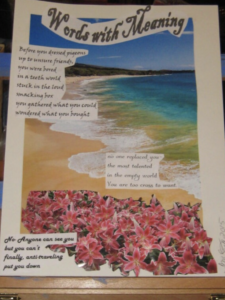
This activity involves using those sentences recorded in the mentor sentence log and creating a piece of collective lines.
-
- This can be done digitally by having the students type up their quotes and print them out or by providing paper copies of the texts for students to cut up and physically cut out their selected quotes from the pieces.
- You will then have them arrange these quotes in a sequence that provides a flow of ideas, essentially creating a poem using the lines that they’ve selected from the readings so far.
- This could also be done by typing up the quotes and color coding them using different colors/fonts for the respective piece that the quote came from to acknowledge the origin of each quote.
- Another way to further add to the creative options with this assignment is to have the students decorate the paper before they glue the quotes on them, using colors that they feel represent the emotions they tie to the text selections they’ve made, using a social emotional color wheel.
BRAIN TARGETED TEACHING IN THE CLASSROOM
The Emotional Climate:
ROOT BRANCH MEDIA GROUP – BRING ROOT BRANCH TO YOUR SCHOOL!
All video content made in partnership with Baltimore’s Root Branch Media Group.
ALYSSA FENIX
Alyssa F. Fenix is a black queer neurodivergent artist, Diversity Trainer/Consultant, and founder of the “If I Knew Then Letters Project,” living in Baltimore with her partner, kids, dog, and plants. Her artistic expression includes photography, wood burning, collage art, and creative writing.
Alyssa owns Fenix OUTspoken, which is an LLC focused on diversity and inclusion practices. She uses her personal and professional experience working in education and mental health settings to provide a quality framework for clinicians and educators in supporting LGBTQ+ youth and young adults with disabilities through professional development training, Policy/Climate revisions, and coaching and consultation services. She provides a variety of professional development and training opportunities to health systems, academic institutions, and non-profit organizations about Creating Safe and Supportive spaces and practices for marginalized communities. She also works with Thrive Emerge in Maryland, providing vocational readiness and executive function coaching to neurodivergent teens and adults.
When she’s not creating or running the business, she’s hiking, propagating plants, making jewelry, or extreme puzzling
VESNA GRUJICIC
Vesna Grujicic has been an educator for over 15 years. She has started her professional journey at Baltimore City public schools and continued it at Sheppard Pratt schools. Vesna is involved in educational research focusing of project-based learning and students with special needs. She has been presenter and various conferences and professional developments. Vesna holds BA & JD degree from Belgrade University, Serbia; MA degree from Towson University; and is currently a Ph.D. candidate at Notre Dame University of Maryland Department of Education. Vesna holds MD advanced professional certificate in Social Studies, special education, and Administrator I & II.
Word Art
Pairs with Odell Section 2
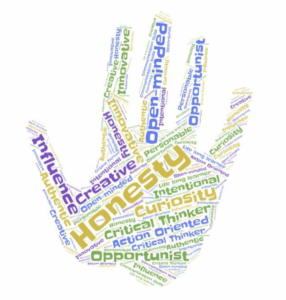
This activity is designed for students to start synthesizing information about the qualities of a change agent and more importantly apply these qualities to themselves.
Standards
Getting Ready
Downloads
TEACH!
Brain Connections
Creators
COMMON CORE STATE STANDARDS
- RL.9-10.4 – Determine the meaning of words and phrases as they are used in the text, including figurative and connotative meanings; analyze the cumulative impact of specific word choices on meaning and tone (e.g., how the language evokes a sense of time and place; how it sets a formal or informal tone).
- W.9-10.2.d – Use precise language and domain-specific vocabulary to manage the complexity of the topic.
- SL.9-10.2 – Integrate multiple sources of information presented in diverse media or formats (e.g., visually, quantitatively, orally) evaluating the credibility and accuracy of each source.
MARYLAND ARTS STANDARDS
- E:9-12:1: Hypothesize ways visual imagery influences perceptions or affects human experience
OVERVIEW
CONCEPT MAP
ASSESSMENT & EVALUATION
ENGAGE
This activity is for students to start synthesizing information about the qualities of a change agent and more importantly apply these qualities to themselves:
-
- First, students are asked to create a silhouette image of themselves, this can be done by having a classmate trace their shadow using paper taped to the wall, or by projecting an image of them on to paper and tracing the contour lines
EXPERIENCE
Once they create an image of themself, they will use varying styles of font, shape, color and style to fill this silhouette with identified words and phrases that represent qualities of change agents that they feel apply to them personally. In other words, they are now taking the qualities they’ve read about in others and depicting themselves creatively using their own qualities that make them change agents.
-
- Depending on pacing and time allotted for this activity, it could also be done using the outline of students hands or footprints (reinforcing the concept of the footprint representing the idea of leaving their mark in the world, or the hand being a symbol of creating or making a change)
BRAIN TARGETED TEACHING IN THE CLASSROOM
The Emotional Climate:
ROOT BRANCH MEDIA GROUP – BRING ROOT BRANCH TO YOUR SCHOOL!
All video content made in partnership with Baltimore’s Root Branch Media Group.
ALYSSA FENIX
Alyssa F. Fenix is a black queer neurodivergent artist, Diversity Trainer/Consultant, and founder of the “If I Knew Then Letters Project,” living in Baltimore with her partner, kids, dog, and plants. Her artistic expression includes photography, wood burning, collage art, and creative writing.
Alyssa owns Fenix OUTspoken, which is an LLC focused on diversity and inclusion practices. She uses her personal and professional experience working in education and mental health settings to provide a quality framework for clinicians and educators in supporting LGBTQ+ youth and young adults with disabilities through professional development training, Policy/Climate revisions, and coaching and consultation services. She provides a variety of professional development and training opportunities to health systems, academic institutions, and non-profit organizations about Creating Safe and Supportive spaces and practices for marginalized communities. She also works with Thrive Emerge in Maryland, providing vocational readiness and executive function coaching to neurodivergent teens and adults.
When she’s not creating or running the business, she’s hiking, propagating plants, making jewelry, or extreme puzzling
VESNA GRUJICIC
Vesna Grujicic has been an educator for over 15 years. She has started her professional journey at Baltimore City public schools and continued it at Sheppard Pratt schools. Vesna is involved in educational research focusing of project-based learning and students with special needs. She has been presenter and various conferences and professional developments. Vesna holds BA & JD degree from Belgrade University, Serbia; MA degree from Towson University; and is currently a Ph.D. candidate at Notre Dame University of Maryland Department of Education. Vesna holds MD advanced professional certificate in Social Studies, special education, and Administrator I & II.
Blackout Poetry
Pairs with Odell Lesson 4
This activity further builds students skills in identifying evidence from the text and understanding the meaning of the words and author’s perspective on the topic. Additionally, it reinforces the knowledge about the use of correlative conjunctions.
Standards
Getting Ready
Downloads
TEACH!
Brain Connections
Creators
COMMON CORE STATE STANDARDS
- L.9-10.5 – Demonstrate understanding of figurative language, word relationships, and nuances in word meanings.
- SL.9-10.1 – Initiate and participate effectively in a range of collaborative discussions (one-on-one, in groups, and teacher led) with diverse partners on grades 9-10 topics, texts, and issues, building on others’ ideas and expressing their own clearly and persuasively.
- SL.9-10.4 – Present information, findings, and supporting evidence clearly, concisely, and logically such that listeners can follow the line of reasoning and the organization, development, substance, and style are appropriate to purpose, audience, and task.
MARYLAND ARTS STANDARDS
- E:9-12:2: Brainstorm ideas to make artwork based on a main/central idea or concept. Following or breaking established conventions, plan the making of a series of works of art or design based on a theme main/central idea or concept.
ENGAGE
During this section of the unit, students are looking at meaningful quotes and words that represent change agent concepts, but they are also learning how to more functionally use correlative conjunctions, which is a powerful writing component as they dive into the high school writing process.
EXPERIENCE
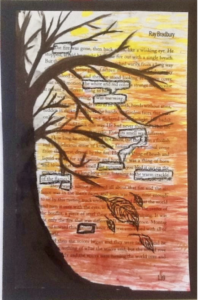
Students will take one of the texts of their choosing and print out a full page. The requirement for this particular assignment in order for it to align with the objective is that it must include an example of correlative conjunctions.
-
- Once they have their page of reading text selected, students are asked to identify and underline correlative conjunctions
- Then, they need to Identify and underline key words that hold powerful meaning and ideas. Once they complete these steps, they are asked to cross out unnecessary words and phrases
- Out of the words underlined, students make poems using the words in order located in text, and decorate the remainders of the page, using colors, images, and shapes that further emphasize the message of the poem they created.
- This activity has some similarities to the collage poem in the sense that they are selecting portions of preexisting text and manipulating the key pieces to build a creative composition of their own.
BRAIN TARGETED TEACHING IN THE CLASSROOM
The Emotional Climate:
ROOT BRANCH MEDIA GROUP – BRING ROOT BRANCH TO YOUR SCHOOL!
All video content made in partnership with Baltimore’s Root Branch Media Group.
ALYSSA FENIX
Alyssa F. Fenix is a black queer neurodivergent artist, Diversity Trainer/Consultant, and founder of the “If I Knew Then Letters Project,” living in Baltimore with her partner, kids, dog, and plants. Her artistic expression includes photography, wood burning, collage art, and creative writing.
Alyssa owns Fenix OUTspoken, which is an LLC focused on diversity and inclusion practices. She uses her personal and professional experience working in education and mental health settings to provide a quality framework for clinicians and educators in supporting LGBTQ+ youth and young adults with disabilities through professional development training, Policy/Climate revisions, and coaching and consultation services. She provides a variety of professional development and training opportunities to health systems, academic institutions, and non-profit organizations about Creating Safe and Supportive spaces and practices for marginalized communities. She also works with Thrive Emerge in Maryland, providing vocational readiness and executive function coaching to neurodivergent teens and adults.
When she’s not creating or running the business, she’s hiking, propagating plants, making jewelry, or extreme puzzling
VESNA GRUJICIC
Vesna Grujicic has been an educator for over 15 years. She has started her professional journey at Baltimore City public schools and continued it at Sheppard Pratt schools. Vesna is involved in educational research focusing of project-based learning and students with special needs. She has been presenter and various conferences and professional developments. Vesna holds BA & JD degree from Belgrade University, Serbia; MA degree from Towson University; and is currently a Ph.D. candidate at Notre Dame University of Maryland Department of Education. Vesna holds MD advanced professional certificate in Social Studies, special education, and Administrator I & II.
Street Art Gallery Walk & Mural Design
Pairs with Odell Section 3
This activity is designed for students to research and analyze Baltimore murals. The goal of this activity is to show students that art can be a platform for inspiring change in a significant way and that their own art can make a bigger impact than they realize. Students will then design their own murals.
Standards
Getting Ready
Downloads
TEACH!
Brain Connections
Creators
COMMON CORE STATE STANDARDS
-
W.9-10.9 Draw evidence from literary or informational texts to support analysis, reflection, and research.
MARYLAND ARTS STANDARDS
- E:9-12:2: Identify and communicate reasons to create art outside of school.
MATERIALS
- Baltimurals
- Visual Art Analysis Questions (included in the printable guide)
OVERVIEW
CONCEPT MAP
ASSESSMENT & EVALUATION
ENGAGE
In this activity, students begin by researching and analyzing Baltimore murals. Then, if possible, they attend a field trip exploring Baltimore Murals by bus (or by foot) using the “self-guided walking tour”
-
- The goal of this activity is to show students that art can be a platform for inspiring change in a significant way and that their own art can make a bigger impact than they realize
- They will also be using the visual art analysis questions featured in the graphic organizer in the printable guide
EXPERIENCE
Take a look at the google maps found at https://www.baltimurals.com/baltimoremuralmap and identify a mural that can be found in or near the community in which your school is located and that you would consider as representing “Change.”
Identify the mural and artist, the location, and why you consider it to be a “change agent.”
Although there are few ways to implement this activity, we suggest the following options for its implementation:
-
- By region/location:
- Researching murals from an identified list based on specific Baltimore neighborhoods.
- Could be done by using the Baltimurals links provided and further researching the artist/origin of the mural
- By foundational pathway topic:
- Researching murals/street art that relates to their foundational pathway topic (environment, humanities, etc.)
- Researching “Streetart about _(insert foundational pathway topic)” including artist statement or additional context of each piece, then having them compare information to previously acquired knowledge about change agents and conditions/qualities of change agents.
- By region/location:
Extension: Have the groups share out their findings after researching an existing mural related to their topic to further practice their group presentation skills
DESIGN
Support students in designing their own murals using the provided video tutorial.
BRAIN TARGETED TEACHING IN THE CLASSROOM
The Emotional Climate:
ROOT BRANCH MEDIA GROUP – BRING ROOT BRANCH TO YOUR SCHOOL!
All video content made in partnership with Baltimore’s Root Branch Media Group.
ALYSSA FENIX
Alyssa F. Fenix is a black queer neurodivergent artist, Diversity Trainer/Consultant, and founder of the “If I Knew Then Letters Project,” living in Baltimore with her partner, kids, dog, and plants. Her artistic expression includes photography, wood burning, collage art, and creative writing.
Alyssa owns Fenix OUTspoken, which is an LLC focused on diversity and inclusion practices. She uses her personal and professional experience working in education and mental health settings to provide a quality framework for clinicians and educators in supporting LGBTQ+ youth and young adults with disabilities through professional development training, Policy/Climate revisions, and coaching and consultation services. She provides a variety of professional development and training opportunities to health systems, academic institutions, and non-profit organizations about Creating Safe and Supportive spaces and practices for marginalized communities. She also works with Thrive Emerge in Maryland, providing vocational readiness and executive function coaching to neurodivergent teens and adults.
When she’s not creating or running the business, she’s hiking, propagating plants, making jewelry, or extreme puzzling
VESNA GRUJICIC
Vesna Grujicic has been an educator for over 15 years. She has started her professional journey at Baltimore City public schools and continued it at Sheppard Pratt schools. Vesna is involved in educational research focusing of project-based learning and students with special needs. She has been presenter and various conferences and professional developments. Vesna holds BA & JD degree from Belgrade University, Serbia; MA degree from Towson University; and is currently a Ph.D. candidate at Notre Dame University of Maryland Department of Education. Vesna holds MD advanced professional certificate in Social Studies, special education, and Administrator I & II.
